Monday, 7 November 2016

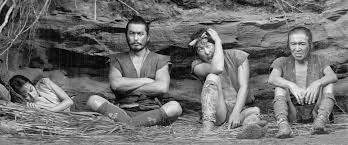
The Hidden Fortress (1958)


Off-List: The Hidden Fortress
Two years ago or so I bought a box-set of Kurosawa movies thinking that with all the Kurosawa films on the List that would be a convenient solution. As a bonus the box-set includes titles not on the List and given the Kurosawa track record those are must-sees as well. One of these is “The Hidden Castle” from 1958. I know, I am already past 58, but so what?

“The Hidden Fortress” is famous for being the inspiration for “Star Wars”. George Lucas has openly and repeatedly mentioned that and in my silly head that made me expect an early version of “A New Hope”, which is not at all what Lucas meant. Inspiration is not the same as a remake. As a result I was somewhat disappointed by “The Hidden Fortress” and only near the end did I come to terms with the fact that this was not even intended to be “A New Hope”. Instead “The Hidden Fortress” is more akin to “The Stagecoach” both in plot and feel.

The one element Lucas did pick up from this movie was that the story is told from the viewpoint of the lowest characters. In Star Wars it was the droids, in “The Hidden Castle” it is the two peasants Tahei (Minoru Chiaki) and Matashichi (Kamatari Fujiwara). They are cowards and clowns like the droids, but a lot more than that. They are greedy, opportunistic, stupid and vicious. In fact they have no redeeming features at all, not even loyalty to each other. They are funny like the droids, but not sympathetic at all. We never love them but take pleasure in mocking them for their small minds and petty squabbles. To place two so comical, yet unsympathetic characters in the foreground was something new Kurosawa brought to the table and while interesting it only works half way. Lucas fixed that by making the droids sympathetic.

The peasants find themselves on the wrong side of the border in a bloody civil war. I am not sure of the period, but these are samurai with guns so seventeenth century is probably not entirely off. While on the run from yet another prison camp they stumble upon a gold treasure hidden inside firewood. The gold belong to the defeated Akizuki clan, whose remaining members are hiding out in a hidden fortress in the mountains. The two most important members are Princess Yuki Akizuki (Misa Uehara) and General Makabe Rokurota (Toshiro Mifune). Rokurota is a tough samurai who unflinchingly sacrifices his own sister for the cause so when he takes in the peasants it is not a friendly partnership, but simply a new master for the peasant although it does take a while to seep through their dense skulls. The princess is a true aristocrat and together as the venture out to find a route through the enemy lines they are a motley group.

This voyage is like in “The Stagecoach” the core of the movie. As they travel the land and encounter all sorts of hazards they learn a lot about each other and we learn about them. The Princess see a world she has never known and take pity and the general for all his valor learns humility. Only the peasants never seem to learn anything until the very last scene of the movie.

I really did not like Misa Uehara as the princess. Her pose as a tom-boy with a whip in her hand certainly conveys strength and superiority and is effective almost as a caricature, but as soon as she opens her mouth it falls apart. She sounds utterly hysterical and while I feel certain it is a cultural thing and that I just do not get it, it does make her sound annoying and half out of her mind.

The parallel to the western genre is the selling point of the movie. It is such an interesting idea to place a western in ancient Japan and although Kurosawa was already here in “The Seven Samurai” “The Hidden Fortress” is much more true to the western genre. If you had any doubts they would finally evaporate in the final escape scene on horseback with a western theme on the soundtrack.

This is not my favorite Kurosawa, not by a long shot, also after recovering from my disappointment of not seeing more of “Star Wars” in it, and I understand why it is not on the List. Yet, it has enough quality and plenty of interesting components to warrant a viewing and I know that I will probably end up liking it a lot better over the next few days as the dust settles.   

Tuesday, 1 November 2016

Ride Lonesome (1959)


Ride Lonesome
With ”Ride Lonesome” we are back in western land, a favorite genre of the fifties it seems. I can almost feel the groan coming (oh no, another western, oh no, another western bashing), but this is neither. “Ride Lonesome” is actually quite interesting.

According to the Book and Wikipedia director Budd Boetticher made a series of westerns with Randolph Scott. I have no idea how that worked out as a series, “Ride Lonesome” is the only one I have seen, so I do not know if there is a progression or if “Ride Lonesome” is typical. What I do know is that the western genre has developed quite a bit through the fifties, eventually leading up to the Leone westerns of the sixties. What I find very interesting is that the boundary between good and bad, right and wrong is getting blurred. There is no such thing as a white knight out of medieval chivalrous novels (you might want to consult my book blog on those). Instead the heroes are flawed and may even approach the status of antiheroes. At the same time the bandits are not condensed evil, but may be more complex or as in “Ride Lonesome” reformed to the extent that we do not know where to place them. In the same vein good or bad actions are not what they seem and in that grey zone people get a lot more real and interesting.

In “Ride Lonesome” the one we hang on to is Randolph Scott’s bounty hunter Ben Brigade. He is Gary Cooper light with the same posture, same clipped speech and same ramrod integrity. He has caught a wanted murderer, Billy John (James Best) and is taking him to town. We are not in doubt that he is the one we vouch for, he keeps doing the right thing. Or does he? Increasingly he says things and acts as if something is not right and he is being way too callous.

At a shift station Brigade encounters Sam Boone (Pernell Roberts) and Whit (James Coburn), two wanted men, as well as the station manager’s wife Carrie Lane (Karen Steele). First appearance is that Sam and Whit are keeping Carrie prisoner. Is Brigade going to rescue a damsel in distress from two bandits? Nope, it gets a lot stranger than that. The local Indians are on the warpath and forces the group together and soon they are riding out towards Santa Cruz to bring in Billy John for his hanging. Sam and Whit wants Billy John for themselves. Not for the money though, but because there is amnesty to those who bring him in. As Brigade does not want to give up his prisoner Sam and Whit seem likely to simply kill Brigade.

Here is the question: Is Brigade as clean as he seems and are Sam and Whit as bad as they appear? The witness is Carrie who is thus our eyes and ears and she is confused.

I like it when movies play with the stereotypes and makes us reconsider our prejudices. I admit that it can be done even better as Leone would show us a few years later, but even to ask this question in the chivalrous genre of the western is interesting.

If “Ride Lonesome” has a flaw it is that it is too short, only 70 minutes. It spends effort describing characters who are more than two dimensional types, but leaves me hungry for more. It is obvious there is a lot more to these characters that could be explored and the Carrie Lane character deserves a larger role than just being the observer with the questions and the eye candy. Dumping a girl like that into a group of lonely men should spark all sorts of drama, but it does not and besides being unrealistic it does seem like a missed opportunity.

“Ride Lonesome” is not the greatest western ever, but it is still worth watching and with its short running time it is certainly an easy watch.

Friday, 28 October 2016

Eyes Without a Face (Les Yeux sans Visage) (1959)


Øjne uden ansigt
When it comes to horror I am pretty easy. You do not need to roll out the big guns of ghosts and zombies and chainsaws. Show me a medical procedure and I am pretty much done for. Yeah, I am rather squeamish when it comes to that. In my childhood I got so nauseous from reading a medical lexicon that I fainted and broke my nose. Try imagine what an explicit presentation of a face transplantation from one living human being to another would do to me.

This is exactly what “Les yeux sans visage” or “Eyes Without a Face” offer. If there was nothing else to the movie it would be enough for it to qualify as horror in my book. Yes, I did have to look away, it was just too awful.

But “Les yeux sans visage” is a lot more than that. It is a chilling story about a doctor (Pierre Brasseur as Doctor Génessier) who caused his daughter’s (Edith Scob) ruined face in a car accident and now tries to undo the damage by transferring the skin of another woman to his daughters face. It is not so easy though. Doctor Génessier needs a lot of attempts to get it right and the donors are ordinary living women who would sadly miss their face when they wake up. That little detail is handled by killing them off as they move along. So in the process of absolving his crime to his daughter doctor Génessier becomes a mass murderer of a monster.

Doctor Génessier is assisted by Louise (Alida Valli) whose job it is to find the girls and lure them out to the doctor’s mansion. She seems to accept the procedure, but Christiane, the daughter, is increasingly having misgivings, partly because of the destruction of the donors and partly because the transplantations only lasts a few days.

As a synopsis this is bad (as in “scary”) enough with a Dr. Death on the prowl, but the execution has a dreamlike quality that makes the story unfold as a nightmare. The photography is the big hero here. It is artistic and ethereal in a way that reminded me of Jean Cocteau. It is difficult to describe, but is like the antithesis of the ultra-realism of Goddard in the  “Les Quatre Cent Coups”. There are no raving lunatics or sudden outbursts here. If anything there is a great sadness as if we almost understand the obsession of the doctor.

Christiane has to wear a mask to protect her face and that works very well to promote the ethereal feel of the movie. It is absolutely crazy what a mask does to a human being. Something very humane is taken away and yet this creature is enormously fragile. And behind the mask lurks the monster…

In the periphery of the story is a police investigation of the missing women. The detectives may have gotten a potential breakthrough when suspicion falls on Doctor Génessier and they send in a girl as bait. The conclusion of the police however is that Doctor Génessier is innocent and the girl would have died if the story had not taken a dramatic turn. I think that is interesting. Normally in this sort of movie the cavalry will come charging in at the end to save the day, but here the cavalry is impotent, almost irrelevant. Instead this is all about father and daughter. I have this feeling that there are references here that I am not even aware of.

I liked this movie a lot more than I thought I would. It is an effective horror movie, but it is a lot more than that and filmed in a poetic fashion atypical of horror. Georges Franju, the director, made a very unique movie, one that absolutely deserves a watch.

Also there is a warning about keeping dogs. Terrifying animals.  

Monday, 24 October 2016

The World of Apu (Apur Sansar) (1959)


Apu's verden 
Apur Sansar is the third installment of the Apu trilogy by Satyajit Ray and in many ways the best of the three. It is very obvious how Ray has improved over the years in his filmmaking and getting more adequate resources to do so. Where his earlier movies were a tad uneven this one has a very high production value. That Criterion has had it under their wing did no harm to it either.

Despite this excellent quality Apur Sansar is no walk in the park. Ray is continuing the bleak story along much the same lines, which essentially means that whenever things seem to righten themselves for Apu someone close to him will die and throw his life up in the air again. In the first movie it was his sister, in the second his parents and in the third one it is his wife. Yes, the movie does end on a happy note, but had there been a fourth movie I know exactly what would have happened and that boy is just too sweet.

Additionally it is not a glamour side of India we get in Ray’s movies, but instead the pervasive poverty and social injustice that is so glaring when you go there even today. I suppose that makes his movies important and all, but I find it rather depressing. Recently I found out that I am scheduled to go to New Delhi in April next year and frankly this is not my favorite destination.

Apur Sansar starts where the second installment ended. Apu (Soumitra Chatterjee) is a promising academic who leaves college rather than continuing at university to live a free an untroubled life pursuing a career as a writer. We get hints that his writing is very good and there is real hope that although he is only scraping a living he might get successful as a novelist.

His friend Pulu (Swapan Mukherjee) shows up and want him to join him for a family wedding. Pulu is clearly from a wealthy family and the wedding is taking place at the family palace in the countryside. Unfortunately the groom turns out to be a madman and Apu with his pretty face and likable demeanor is coaxed into marrying the girl instead cause married she must be.  Apu is at first upset about this but the girl, Aparna (Sharmila Tagore) is a very sweet girl and it is soon clear that they fit each other very well. 

Then disaster strike again. Aparna return to the family home to give birth and dies in the process. The child survives, but Apu is devastated and throws his life out the window. He begins a wandering, aimless life and avoids taking charge of his son. It takes his friend Pulu to make him go back to face his now five year old child in a heartbreaking encounter.

I find Indian culture quite incomprehensible, it is so alien to anything I am familiar with, and so I get the feeling that there are elements and aspects in Ray’s movies that I am entirely missing or only scratches the surface of. An example is the obvious difference in status between Apu and Aparna. In any society a rich girl marrying a poor boy is a matter of concern, but in India these people would belong to very different castes. That has to imply some added difficulties and it bothers me a great deal that I am clearly missing something. The same goes for moral codes and cultural subtexts. The idea that Aparna must be married at this celebration is from a western perspective slightly comical and that Apu obliges is almost incomprehensible. They do not know each other at all.

What I do understand is the complete devastation Apu feels when he loses his wife and his torn feelings toward his son. And that meeting of father and son touches me very deeply. My own son is not much older than Kajal and I can see him in this boy.

Of the three movies this final chapter is my preferred one. Not just because of the technical improvements, but it simply works better for me. I never found it dull and it does contain enough elements that I understand that I can follow it. It also help that Ray did excellent casting for both Apu and Aparna.

Monday, 17 October 2016

Some Like it Hot (1959)


Ingen er fuldkommen
Comedies do not age well. Sadly, really, because I love good comedies. It is something about the cultural references that change over time, I suppose. It is one reason the List is so thin on comedies. Most comedies that do survive are those that rely on physical comedy, such as the silent masters or Tati.

This is why I am super delighted that “Some Like It Hot” comes a long and proves the exception to the rule. It is not a physical comedy (not at heart at least), but more of a situational comedy, thick with wonderful dialogue. It is a comedy that is funnier than most comedies made today and immensely more charming. “Nobody is perfect” but “Some Like It Hot” is damn close.

Okay, I think I made it clear that I love this movie. It is an absolute bliss to watch and it totally makes me crack. Not just the happy, fuzzy smile, but the Oh-God-I-Cannot-Watch-He Did-Not-Do-That roaring laughter. Man, I needed that. Those last few weeks have been terribly busy and this movie is the second best medicine (getting less busy is after all the best). In fact I would prescribe this movie to anybody with any sort of trouble.

If you do not know this movie I will personally spank you. Even I knew it and not just of it. “Some Like It Hot” defines a classic movie on par with “Gone with the Wind” and the Indiana Jones movies and a synopsis would be a waste of time.

Here is instead all the wonderful things this movie provides.

Jack Lemmon, Tony Curtis and Marilyn Monroe is career defining roles. As a trio they are just perfect. Tony as Joe/Josephine is the guy with all the harebrained scams and Jack Lemmon as Jerry/Daphne has that perfectly timed wackiness that makes him wonderfully funny without going over the (Jerry Lewis) top. In fact, they accomplish successfully what Martin and Lewis tried and failed to be. And Marilyn Monroe is of course the star. If you ever wondered about her reputation and “Gentlemen Prefer Blondes” did not convince you then “Some Like It Hot” will. She is perfect as the silly, but sweet blonde bombshell. If anything she is almost too good for the band she is supposed to sing in. I would have liked to say that her comedic timing was perfect, but I read that she was so high on pills that she could not remember her lines and her scenes had to be taken dozens of times to get them right. Sad, really. Wikipedia writes that when Billy Wilder was asked about another movie with Monroe he answered:  "I have discussed this with my doctor and my psychiatrist and they tell me I'm too old and too rich to go through this again."

Billy Wilder of course has a large share in this movie. He is one of my favorite directors and certainly one of the most versatile. He excels at every genre and his trademark is that his movies always have bite. Even “Some Like It Hot”. It went far beyond the production code in what you could show, say and do. Cross dressing, hints at homosexuality and a Monroe so hot that she could wake a dead, which is incidentally what she is supposed to do (Tony Curtis in his third incarnation as the emotionally crippled Shell heir). Wilder always challenged his viewers and never followed the standard recipes. That makes him a star in my eyes.

Then there is the music, oh boy. As the music is supposed to take place in the late twenties we get a jazzy score that is warm and fuzzy throughout, but when Monroe gives her songs we go a notch up and hit the roof. All her songs in this movie are classics, none more than “I Wanna Be Loved by You” but it is “I’m Thru with Love” that swipes my feet away. It is no wonder Joe/Josephine gives up her pretense and goes up to kiss her right there and then. I would want to do that.

I was trying to think of the funniest part in the movie, but gave up. There are just too many candidates. There are chase scenes, pretense scene, witty comments scenes, outrageous scam scenes, awkwardness galore… just too many to mention, and the crazy thing is they all work, even today. “Tootsie” owes a lot to this movie and any comedian on the run from the mob plot derive from “Some Like It Hot”. This may well be one of the most influential comedies ever made, if not the funniest.

1959 is a great year so far, I love it already.

Sunday, 9 October 2016

Anatomy of a Murder (1959)


Et mords analyse
I am not a big fan of courtroom movies.

It is not for lack of drama or poor performances, but the dirty feeling I get when I see right and wrong, truth or falsehood being settled by a fencing match between smart-talking lawyers. To my mind the idea of a court is as a place where the truth is revealed and judgement is sentenced. Okay, maybe I am naïve, but when I see how relative truth and justice is I always get depressed.

“Anatomy of a Murder” is both a well-made and engaging drama and an exposé of that very relativism. On the one hand we have what a appears to be the good guys fighting an uphill battle against a fancy lawyer and a very serious charge of murder and on the other a nagging feeling that we are rooting for the wrong people and that Preminger, in his usual subverting style, want us to see the weakness of the system.

James Stewart as Paul Biegler is a small town lawyer in his usual calm, common sense style. He is the one we have to root for. Paul lost his position as district attorney to a smart-ass lawyer and is scraping along with an underpaid secretary and an alcoholic friend. Then comes the case that might bring Biegler back in business. He is approached by Laura Manion (Lee Remick) whose husband Lt. Frederick Manion is charged with murder and although this seems like an almost impossible case Paul Biegler manages to get it turned around.

Here is the problem: Lt. Manion is guilty as hell. He did kill the barkeeper Barney Quill. Several witnesses saw it and he even turned himself in. However the defense manages to emphasize the reason for the murder, that Laura was raped by Barney and that that made Manion so upset that he went to kill him. Somehow by proving that Laura was raped by Barney the murder is okay and Lt. Manion is cleared… uh, what???

I do not seem to recall any legal system where it is permissible to grab a gun and shoot somebody because you are royally pissed. That is what police is for and that kind of vigilance is usually looked upon as more serious than the crime itself.

Also as we learn more and more about Laura and Frederick Manion the more unlikable and suspect they become. Laura had something very unpleasant coming, calling her a slut is not far off and I actually like adventurous and daring women, but Laura is cheap and stupid and run for easy and fast gratification. Lt. Manion is an aggressive brute and extremely jealous. The way he looks at people is friggin’ scary. I feel almost sorry for Barney Quill. Had it not been him it would have been somebody else, he just happen to be the one getting clinched.

If anybody ever deserved their punishment it would be these two, yet because they got such a likable and shrewd lawyer as Paul Biegler they end up walking away from outright murder. And we as audience is on their side, especially since the prosecutor is an arrogant asshole by the name Claude Dancer (George C. Scott).

This may be the story of David vs. Goliath and hoorah for the underdog, but I see it as a story about manipulation of the legal system leading the court to make the wrong decision and we are supposed to condone it.

If I just take a minute to calm down from this frenzy I have worked myself into I will easily admit that it is a very nicely composed movie with excellent acting all round. The rather long running time actually fly by, a typical Preminger trait. Yet the winner here and the reason I cannot dislike this movie is an absolutely brilliant soundtrack by Duke Ellington. Man, this may be my favorite soundtrack from the birth of sound movies until 1959. The music fits and carry the movie, lending it a groove and the mood. It is exactly the kind of music I like and at times I would just dip into the music and not care so much about what was going on in the movie.

“Anatomy of a Murder” is a good movie, maybe even an excellent movie, but it is also a movie that makes me angry and reinforce my antagonism for courtrooms and smart lawyers, even likable ones played by James Stewart.

Tuesday, 4 October 2016

North by Northwest (1959)


Menneskejagt
Now here is a movie I have been looking forward to see for a long time. I did see it once many many years ago and my memory of it was so faint that I felt I could enjoy it as a first viewing this time round. But this is not a movie you can be ignorant about. “North by Northwest” is one of the most referenced movies around and you cannot blog about movies for long before encountering the “yeah, it is good, but compared to North by Northwest…”. So, there is that little anxiety that this movie is over-sold.

Well, I need not have worried. “North by Northwest” is exactly as good as its fame and probably better. It is one of those movies I enjoy from start to finish and all the little bits in between. It is one of those movies where all the components work to make it thoroughly enjoyable, even if it is, when you start thinking about it, a bit silly.

If you are reading this blog I would bet a fiver you already know this movie and so there is hardly any need for a summary. You will also know that this is Alfred Hitchcock, and knowing that the frequent reader will know that I am predisposed to the movie.

Alas, this is the classic Hitchcock theme of the wrong man in the wrong place, the mistaken identity theme where the protagonist is way out of his depth. Hitchcock really loved this theme. However where “The Wrong Man” was a dark and serious rendition of that theme and “The Man Who Knew Too Much” placed Mr. Ordinary in the world of spies, “North by Northwest” is a much more fun story. Yeah, there is death and destruction but the tone is much lighter and you can see how much fun Hitch had with this story. It is not a comedy, far too much tension and suspense for that, but Cary Grant as the unfortunate Roger Thornhill cannot help being charming and funny and he is helped by a script that allows him to be witty and amusing. I learned in the extra material that James Stewart were considered for the role, but that would have been an entirely different movie and he would not have hit the notes that makes this movie special. Yet, Grant also needs to be restrained. He is constantly balancing on that edge where he becomes a reprisal of those comedies that made his fame back in the thirties and forties. But a slick and charming yet superficial advertising agent is exactly the role Grant can do.

As in “39 Steps” and “Notorious” the actual crime is not really that interesting. Something about smuggling microfilm out of the country. We do not even know who the villains are working for, but it does not matter. This is all about the chase and the mixed up identities. Vandamm (James Mason) is hunting Thornhill because he thinks he is a government agent onto him, though that agent only exists is a decoy to protect the real agent. Thornhill hunts Vandamm because he is getting deeper and deeper into a mess of drunk driving, car theft and murder and Vandamm is the only one who can provide the answer. Trouble is Vandamm is a professional, Thornhill is an advertising agent. That sounds terribly uneven, especially when Thornhill is also chased by the police. Add to that a knock-out blonde who may not be what she seems to be (Eva Marie Saint as Eve Kendall) and you have the ingredient for a very exciting, witty and inventive double chase.

This is 1959 and the action may seem a bit lame and slow by today’s standard, but for me it works beautifully. I love when a movie takes its time at the right places, then accelerate when it matters and that is exactly what Hitchcock does. We have eight minutes in a cornfield with absolutely nothing happening and then suddenly a plane explodes out of the sky and knocks Thornhill over, tries to shoot him and finally flies straight into a gasoline truck. Woohaa. That is a master at work.

I revel in the intricacies of the story, of the plots within plots as in the old noirs and the beautiful shots, but the winning stroke is the sheer charm. You cannot watch this and not get happy. It is everywhere, even in the heavies and has a lot to do with brilliant casting. James Mason was always villain numero uno, Eva Marie Saint is cool and not dowdy at all, Martin Landau of course got a great career ahead of him and then of course Cary Grant.

Finally the inevitable question: Is this the best Hitchcock ever? I could say that I do need to watch them all first, but that is just stalling. The truth is that I could not make that decision. There are at least a handful contenders to that title already and it would depend on my mood of the day. Suffice to say that there is absolutely nothing wrong with North by Northwest. It could be accused of being a remake of “39 Steps”, but it is so much better so that does not even count as a detraction.