Monday, 29 May 2023

Atlantic City (1980)


Atlantic City

“Atlantic City” is a pseudo-American movie in the tradition of foreign filmmakers trying their hand on an American genre. In this case it is a Canadian production with the French director Louis Malle at the helm. Sometimes this results in refreshing takes on genres we thought we knew, such as Sergio Leone’s westerns, but more often it is either a pastiche or something a bit off from trying to add a foreign (usually European) element to the movie. “Atlantic City” falls into this last category.

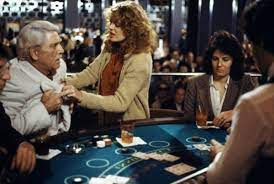
In a rumpled Atlantic City, worn down by decades of use and abuse, Sally (Susan Sarandon) works in an oyster bar and trains to become a croupier. One day her husband, Dave (Robert Joy) shows up with Sally’s sister (Hollis McLaren) in tow. She is heavily pregnant with his child, and he has stolen dope from the mob which he intends to sell in Atlantic City. Sally is less than pleased.

In the same miserable building lives Lou (Burt Lancaster). He used to be a low-level gangster, but in his dreams he was a big shot in his youth. Now he is “kept” by Grace (Kate Reid), a former beauty queen and wife of Lou’s former boss. Not exactly a healthy relationship. Dave meets Lou and together they sell the dope for a small fortune. Unfortunately for Dave, the mob shows up, royally pissed, and kills Dave.

Lou has a thing for Sally and uses a lot of the windfall to woo her, but Sally gets fired because of her former husband and the gangsters are after both her and Lou and so they have to get out of this pickle together.

The dominant feeling in this movie is sadness. Overwhelming sadness. Atlantic City looks horrible, a place ready to be razed. The casinos look desperate and artificial, like a taped-on smile. Sally’s life is barely sticking together, but fueled by the hope that as a croupier she can get out of this dump. Lou is living a dismal and demeaning life filled with his dreams of his former glory, real or not, seeing a kick-ass gangster life as the top of the pops. Grace, his woman, is not much better, but adds a ton of bitterness to the mix. Dave is just a lousy looser and Sally’s sister lives in her own world that is put together in a different way that ours (she does not really believe in gravity…). As I mentioned, sadness all round.

The plot is not much different from that. Dave hopes that the big score from selling the dope will solve his problems, but he just gets killed for the effort. Sally’s dreams of going to Monaco gets shot down when she gets fired. Her former trainer even tries to set her up as a prostitute. Lou gets to live his dream as a kick-ass gangster with money and him regaining his self-respect is probably the most positive outcome here. Desperate and sad.

I like Louis Malle, he did some marvelous movies (Like “Au Revoir, les Enfants”), but here I think his European touch is just to make the actual lives of his characters extra miserable, while their dreams are even more unreachable. A bit like Herzog in “Stroszek”. As in exposing the fabled American Dream as desperate and unrealistic. It also, in my opinion, suffers from production value issues. Not on the acting side, the acting is great”, but the production just does not feel tight enough, even a bit sloppy or cheap at times.

“Atlantic City” is not a complete misery feast, but not for lack of trying. It is difficult to get it entirely bad with Susan Sarandon and Burt Lancaster in the leads, but what it is aiming for is so dirty and sad that I cannot help feeling like I need a shower after watching this.

The Academy loved “Atlantic City”. Although it did not win any awards, it was nominated in five categories, including the four big ones. I guess that is a testament to being successful at what it sets out to do. I am just not certain I can deal with that much sadness.


Thursday, 25 May 2023

Ordinary People (1980)


En ganske almindelig familie

I am back after a small hiatus, spent in rainy Italy, ready to get started on the eighties. The first film of this decade is “Ordinary People”.

Considering how much exciting stuff is waiting for me, I was a bit disappointed starting with what looked to be a dull and pedestrian movie and it really is a movie that starts out as a slow and plain movie, but, boy, was I wrong thinking this would be dull and ordinary.

The Jarrett family is an upper middle-class family consisting of mum Beth (Mary Tyler Moore), dad Calvin (Donald Sutherland) and teenage son Conrad (Timothy Hutton). It appears to be a normal family, but something is off, and we learn, slowly, that the elder son Buck has died and that Conrad has recently returned from hospital after trying to kill himself. Beth is trying to make everything look normal and perfect, but Calvin is concerned for Conrad. He just does not know how to approach him. Conrad is feeling miserable. It is clear that the accident hurt him badly, mentally, and he looks like he is about to implode. Conrad starts seeing a psychiatrist (or psychologist, it is not entirely clear), Dr. Berger (Judd Hirsch) who is able to offer something neither friends nor family can give him, an opportunity to talk about how he feels and open up to the pent-in frustrations. Turns out Conrad feels a lot of guilt for surviving the boating accident that killed his brother.

A lot of the movie is about what happens in the triangle of Beth, Calvin and Conrad. To Beth, all this happening to Conrad is pure sabotage to her perfect façade of a life. She has no interest in opening up for anything messy and whatever happens should certainly stay inside the family. To Conrad, this comes off as a rejection of his feelings and a lack of understanding and interest in what he is going through. He cannot help thinking that she has no love for him and even blame him for Buck’s death. He may not be far off. The dynamic between Calvin and Conrad is better, but Calvin is stuck between the two, letting himself be controlled by his wife and inability to offer Conrad the support he feels he needs. To Beth, Calvin is simply pandering to Conrad instead of taking the firm hand he needs. To Conrad, he is just useless.

Dr. Berger does help Conrad and those scenes are terrific. I almost suspect that this movie was sponsored by a US shrink association as advertisement. Dr. Berger is really good. For Conrad it also helps that he starts seeing a girl, Jeannine (Elizabeth McGovern), but as Conrad starts to face his issues, it also cracks up his family. The remarkable thing here is how honest they all get once the facades crack, how much it hurts and how much it is needed.

It is easy to see Beth as the villain and maybe she is, but she only remains so because of her unwillingness to deal with it. Maybe again an advertisement for the shrinks. As a viewer, I never thought in terms of good or bad guys, but just an intense sadness for the issues they are carrying around. The unfolding of that story is one of the most remarkable dramas I have watched in a very long time. Conrad may be the center of attention, but I felt very strongly for Calvin. Watching him face his own situation and realize his priorities, which would and should always be his son, was like watching an epiphany. I felt like giving him a hug.

“Ordinary People” was nominated for six Academy awards and it won four: Best Picture, Best Director, Best Supporting Actor (Timothy Hutton) and Best Screenplay. On the face of it, this looks like Academy pandering to an intellectual human interest story, but that is only until you actually watch it. It is still early days for me for 1980, but in any year, this would be one of the most interesting movies to watch.   

I strongly recommend “Ordinary People”. It is not nearly as depressive as it sounds, cathartic is more like it, and it feels real like few movies. Watch it.


Friday, 12 May 2023

Finishing the Seventies

 Finishing the Seventies

With “Christ stopped at Eboli” I am now done with not only 1979 but the seventies as a decade. This took me 3 years and 4 months.

The seventies represent my earliest childhood. I was born in 73, so actual memories from this decade are scarce and I do not remember actually watching any movies until the eighties, but I still feel a a familiarity with the decade. As a child, the seventies were considered a depressing decade. Two oil crises, rampant inflation and a social consciousness aimed at taking the joy out of anything. Watching things from the seventies was dull, brown and depressing. This impression has been stuck with me for years, but slowly, starting some time in the nineties, all the cool stuff that the seventies also were, started coming back. Music and fashion (well, some of it…) to begin with but over time many other things. The seventies was also the innocent period before HIV, the counterculture was still strong and a lot of what we take for granted was borne out of the seventies: The computer I am writing on just now, the renewable energy that is my job and a consciousness that the resources of this Earth are finite.

In cinema, the seventies were also the period where many of the filmmakers and actors who have dominated cinema this past fifty years, were formed. Most of these came out of independent cinema with unique and innovative approaches to filmmaking. Directors like Spielberg, Lucas, Scorsese and Lynch are just the top of the iceberg. Sure, some of these started out in the sixties already, but it was the fertile environment of the seventies that gave them their shot. There may not be as many great movies in the seventies as in the eighties, but the creativity and the growth layer are probably the most interesting in movie history. When I made my top-10/20, I listed the movies I like the most, but had the criteria simple been for being interesting and inventive, this might have become a very different list.

That brings me to the traditional top list of the decade. As usual it was incredibly hard to select the 20 best movies and even harder to narrow it down to 10 movies. My main criteria for selecting one movie over another on the top-10/20 is that I would watch it again, maybe even several times. Which of these is the very best of the decade, uhmm, ask me in 10 minutes and I would suggest something else, so I think will abstain from making a choice there.

In chronological order the top 10 is:

1.       Harold and Maude

Comedies are more formulaic than most genres, so to see something go so far outside the templates and be funnier than most comedies, is a marvel. One of the funniest movies ever made and the second funniest of the seventies, but certainly the smartest.

2.       The Godfather

While I am not as sold on the Godfather as most people seem to be, there is no denying its status as a masterpiece. Not admitting it into a top-10 would be a travesty.

3.       The Exorcist

The mother of all possession movies, this horror movie succeeds not only in scaring its audience but also drives a compelling story. I am not a fan of horror, but I love The Exorcist.

4.       Spirit of the Beehive

Maybe a surprising choice, but was one of the greatest surprises of the seventies. The charm and the insight of this movie plus the amazing Ana Torrent makes this a winner. Loved it.

5.       Chinatown

Chinatown is a throwback to the noir movies of the forties and does everything right in the process. One of Jack Nicholson’s best roles ever and Polanski at his best.

6.       Monty Python and the Holy Grail

I am a BIG Monty Python fan and The Holy Grail is everything I love about them. It is anarchic and mad and absolutely wonderful. My son and I swap quotes from this movie and never tire of it. The funniest movie of the seventies.

7.       Jaws

Steven Spielberg’s masterpiece is a masterclass in exploiting a condensed scope. It is a very narrow story that manages to go very deep into its subject matter and who cares if the shark does not look real?

8.       Close Encounters of the third kind

Spielberg’s UFO movie is still seminal of its kind and maintains its original magic. There are quite a few First Contact movies out there, but they all have to refer to this one.

9.       Star Wars Episode IV: A New Hope

Do I really have to argue for placing the original Star Wars movie in the top-10?

10.   Alien

Alien is the ultimate confined space monster movie. The monster is not under the bed. It is dripping saliva just behind you.


The 10 movies that just did not make the cut are still excellent movies and another day I would swap a number of them with top-10 movies.

In chronological order:

1.       Dirty Harry

2.       The Discreet Charm of the Bourgeoisie

3.       American Graffiti

4.       Network

5.       Taxi Driver

6.       Halloween

7.       Life of Brian

8.       Breaking Away

9.       Apocalypse Now

10.   Christ stopped at Eboli


Wednesday, 10 May 2023

Christ Stopped at Eboli (Cristo si e Fermato a Eboli) (1979)


Christ Stopped at Eboli

The last movie of 1979 is “Christ Stopped at Eboli” ("Cristo si è fermato a Eboli"), an Italian film by Francesco Rosi. This is a movie adaption of a book of the same name, containing the memoirs of a Carlo Levi, who was exiled from Torino in the North to the village of Aliano in the south of Italy. To all appearances a true story.

This is also exactly what this feels like. This is not a narrative following a classic story arc, there are no first, second and third act or a crisis to be resolved. A Hollywood producer would fidget with worry over this script. Instead, it tells the story of Carlo Levi (Gian Maria Volonté) arriving in Eboli as a well-educated, modern north-Italian man to what must appear to be a backwards and poor community. He is an alien fish as he moves around in the village, observing the villagers with a bemused look. Carlo is indeed an observer who is interested in everything. He paints, he writes, sometimes comments, but he tries very hard not to interfere. In this way he is like a camera among the villagers, except that, because he listens, he also tries to understand.

What Carlo gets to understand is that there is a lot more to these people than the poverty and the illiteracy that the ruling class, the fascist party likes to see. Carlo gets to know them as people and discovers that in many ways they are just as much political prisoners as he himself. There is a kinship despite the apparent gap that makes them embrace him and he care for them. And because Carlo is our eyes and ears, we do too.

I fell entirely under the spell of this movie. In its slow pace I was drawn in and came to enjoy the experience. It is in many ways a parallel to “The Tree of Wooden Clogs” in its passive observation of life as it plays out, but “Christ Stopped at Eboli” worked even better for me. With Carlo we have some actual eyes and a focus. Carlo will make observations that sometimes help explain and although Carlo’s passivity sometimes come about as impotence, it also moves the attention and the interest away from him and onto the life around him. That does not mean that he does not interfere at all. Reluctantly he becomes a doctor for the peasants and in a wonderful scene he has a discussion with Aliano’s mayor and fascist party member, Don Luigi (Paolo Bonacelli), who is censoring his letters out of the village. The letter in question contains observations on the sentiments of the villagers that can be read as a criticism of the Fascist leadership, but instead of picking a fight with the mayor, Carlo is very calm and makes quiet and undeniable observations that even the Mayor has difficultly countering. To all appearances Carlo is servile and obedient and yet pointedly subversive.

There is no doubt this is a political movie and while it is fairly harmless to be political against a fascist past, there is a very relevant and current criticism of the treatment and view of the poor south by the wealthy and dominant north. Every political analysis of Italy I ever read emphasizes this division. This made the movie relevant in 1979 and it makes it no less relevant today. Maybe today the young people of Aliano go to Munich, Bruxelles or Copenhagen instead of New York, but all the mechanisms are the same.

By some strange coincidence, I am actually going to Southern Italy on vacation this Saturday, not to Basilicata, but to Sorrento in Campania. This feels like the perfect warm up to my vacation and although I expect to find amenities a bit improved since Carlo Levi’s time, I hope to still find some of the life and energy of southern Italy.

“Christ Stopped at Eboli” hit exactly the right spot for me. I did not expect it and that makes it only so much better. You may ask, where is the drama? But life lived is plenty interesting as it is. Highly recommended.   


Friday, 5 May 2023

Nosferatu the Vampyre (Nosferatu, Phantom der Nacht) (1979)


Nosferatu

I am not certain what led me to this misunderstanding, but I went into this movie thinking it was the one about the director Murnau trying to make a vampire movie, but finding that the actor playing the vampire is in fact a real life vampire, who goes ahead and feast on the crew. “Nosferatu the Vampire” is not that one (it is called “Shadow of a Vampire) and I had to recover from my disappointment (and grief at my own stupidity) before I could really appreciate this one.

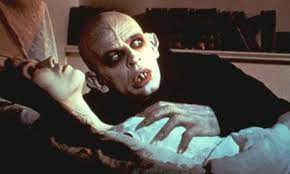
“Nosferatu the Vampire” is instead Werner Herzog’s tribute to the original “Nosferatu” movie from 1922. Or homage may be a better word. This is essentially a remake that tries to reshoot the original movie as it could have looked like in 1979. Scene for scene we find the corresponding scenes in the original, at least for the first half of the movie. Jonathan Harker (Bruno Ganz) is a real estate agent in Wismar, Germany, who is sent to Transylvania to meet with count Dracula to do the paperwork on his acquiring a house in Wismar. Harker is (again) warned by the locals about the undead at the castle and (again) he is braving the forbidden landscape to arrive at the ruined castle where he is received by a courteous but freaky Count (Klaus Kinski). Harker gets trapped at the castle while the Count relocates with all his coffins and rats to Germany on a boat. Of course, the boat is practically a ghost ship when it arrives in Wismar.

Both the tone and the narrative follow the original so closely that it feels like deja vu. We have been over this ground before and despite the haunting imagery, I was frankly a bit bored with it. But as we return to Wismar, Herzog strays from the original and adds something different to the story, not so much in the narrative as in the characters. In Herzog’s version, Harker has become useless and is on his way to become a vampire himself, van Helsing (Walter Ladengast) is impotent as the scientist who refuse to recognize the undead source of the troubles and it is the fragile Lucy Harker (Isabelle Adjani) who must find strength and do what needs to be done to face and get rid of the evil. She alone in the town recognizes and faces Count Dracula.

This deviation makes the second half a lot more interesting than the first half. The seeds for the interpretation is already there in the original, but Herzog makes it explicit and thereby gives it a feministic message, showing the male dominated German bourgeoisie as impotent and weak and not up to the challenge.

The homage to the original also extends into creating the same, or very similar, eerie ambience. There are times where Herzog’s movie comes across as a silent movie with passages of ambience and pictures and where the dialogue, if it is there, is only part of the tapestry. The original sense of melancholy and fatalism is here as well, but more spelled out by making the count more vocal. Where Murnau’s Dracula was almost an apparition, Herzog’s is an actual man trapped in undead form, sad, longing, but still evil incarnate.

Herzog also went a long way to make Kinski look like Murnau’s Count, but it may be that modern color photography is less forgiving. Where Max Schreck gave the appearance that he really looked like a rat, Kinski’s make-up is more obvious (beware of the neckline!). Still the paleness is a good match, and it is interesting that this extends to Adjani’s make-up. In death-like paleness they are quite comparable, as they were in Murnau’s version.

Herzog’s take on the Dracula story is a good one. The production value is high (even if the English language version is a bit awkward) and the ambience is a winner, but the question is if this movie really needed a remake and if a remake does not need to bring something more to the table? Is it enough to just reshoot with better technology?

I do recommend it, but with a tinge of doubt.


Friday, 28 April 2023

Mad Max (1979)


Mad Max

All franchises started somewhere and one of the more successful franchises, the Mad Max franchise, started with a low-cost production called, yes, “Mad Max”. According to Wikipedia it holds the Guinness Book of Records for most profitable film ever. Those two facts are likely why it earned its place on the List.

In some undefined future that looks very much like the seventies, road anarchy is the order of the day. On the mostly empty roads outside of Melbourne, the Main Patrol Force (MPF) has largely free hands to combat misbehaving traffic. Goose (Steve Bisley) and Max (Mel Gibson) are officers of the MPF, wearing leather suits and driving supercharged police cars. They get involved in a war with a biker gang led by an ugly fellow named Toecutter (Hugh Keays-Byrne), a fight that eventually costs the life of Goose. As a result, Max resigns.

Later on, Max is enjoying a little vacation with his wife, Jessie (Joanne Samuel), and their toddler son. Again, they encounter the biker gang who pick out Jessie for a target. Soon the little family is on the run, but eventually the bikers catch up and (SPOILER) do something terrible to tip Max over the edge and send him down vigilante road.

It is not a terribly complicated story and neither the acting nor the setting are particularly impressive. Both scream budget. There is very little to indicate that this is some future and the roads which are 90% of the sets are just empty country roads. I have been on those roads, and they are very… empty. The dialogue is not great, but mostly good enough to avoid outright embarrassment and Mel Gibson is likely the only actor with a standout performance.

What “Mad Max” does is show us a lot of burning rubber. Right from the beginning we are getting high speed chases, cars and bikes being rammed off the road and supercharged engines. The dominant sound of the movie is not dialogue, music or gunfire, but that of revving engines. And those are no ordinary engines. Indeed, there is almost a glee to those sounds.

I have not myself followed the Mad Max franchise. Once, on a plane, I decided to start so I watched this one, but, while I did not outright dislike it, I was not particularly impressed either and I did not follow through with the later installments. Given the amount of money “Mad Max” brought in, I have the impression that production value improved a lot for the following movies, but I cannot confirm that. Somehow, the premise of the movie just does not tempt me enough to give it a shot.

I totally get why “Mad Max” is an important movie, but I cannot say that this is a great movie. It is not even a fun movie to watch unless high speed chases do it for you. It is in fact a rather sad and depressing movie about the cheapness of lives and how basic instincts take over when law breaks down. I can see a coolness factor in some of it, but again, I feel it is a bit off. Those leather-clad police officers look like they are on the way to a… different kind of party and the villains, well, it is almost sweet that they remember to wear proper crash helmets.

On a rather different note, there is something curious about having a film, indeed a franchise, about speeding on Australian roads. First thing you notice when you drive a car there is how slow everybody drives on those very straight and empty roads. They enforce those speed limits very strictly. A few months after returning from Australia in ’16 I got a greeting from Victoria Police sent half the way around the globe for doing 57 km/h where 50 km/h are allowed. I am a road pirate. Lucky, I did not get shot.

Recommendation? Not certain, but if you are into the franchise, I suppose this is where you start.


Saturday, 22 April 2023

Manhattan (1979)


Manhattan

Woody Allen loves New York and “Manhattan” is his love letter to the city. Maybe it is this angle that makes me like “Manhattan” a lot better than most other of Allen’s movie. When he changes the focus a bit away from himself, his movies become so much better.

We follow a few characters who are interconnected and, at least to me, appear more as generic New Yorker types than necessarily particular individuals. Their actions, discussions and problems become an image of the city with its nervous energy, which is what Woody Allen wishes to portray.

Isaac (Allen) is a twice divorced comedy writer who is dating a 17-year-old girl, Tracy (Mariel Hemingway). He is friends with Yale (Michael Murphy) who is married to Emily (Anne Byrne), but secretly dates Mary (Diane Keaton). As friends, Yale is confiding in Isaac about his philandering, while Isaac is quite open about his worries that Tracy is so much younger than him. When Isaac gets to meet Mary is put off by her, considering her a cultural snob, but as they spend more time together a certain energy between them emerges. Isaacs neurotic sarcasm against Mary’s nervous snobbery makes an unlikely, but interesting combo. Maybe it is their honesty about their likes and dislikes that draws them together.

Yale and Mary decide to break up their relationship and that opens the door for Isaac. He in turn breaks up with Tracy and goes all in. Unfortunately for Isaac, Yale and Mary are not done with each other and when they break it to Isaac, he realizes that what he had with Tracy was actually pretty good.

With Meryl Streep as Jill, Isaac’s second ex-wife, now turned lesbian and writing a very revealing book about her relationship with Isaac. Meryl Streep’s role in this movie is not big, but the amount of comedy it brings to the movie is immense. Having an ex-wife who turned lesbian and delivers all your shortcomings with spite and relish to the public is the ultimate in male humiliation.  

The changing relationships here are of course a mess, but it is the dynamics around them that is interesting. The doubts everybody is in, their insecurities, the intellectual facades used to explain away what is basically emotions run amok. Being a Woody Allen movie, the dialogue is of course witty and poignant, exposing the speaker as much as the spoken about. It is fun to listen to, but also makes a lot of sense. Isaac is trying to be the voice of reason but is as little in control of himself as anybody else. The neat thing here is that although Isaac gets a lot of the good lines, this is not so much about Isaac himself as about the situation. Almost all here are narcissists and not only Allen’s character. Tracy may be the only character who is not obsessing about herself, she just is and feels and responds and this may be the realization Isaac comes to, that all the intellectual narcissism does not make him as happy as her unconditional love.

The presentation of “Manhattan” is also interesting. It was filmed in widescreen black and white with a score by Gershwin, which combines to give a nostalgic image of New York as a setting. This classic setting is then offset by these very modern types trying to get their modern selves to work out and the aggregate is thereby a picture of New York as Allen wants us to see it. I am certain the city is many things, but for many, and I suppose particularly people not living there, this is an image that resonates. Allen did a similar love letter to Paris in “Midnight in Paris”, and I think they would make a good double feature. Another option is the more recent Billy Crystal movie “Here Today”, which could be “Manhattan” 30 years later.

I really liked “Manhattan” and I liked it a lot more than any previous Woody Allen movie I have watched. This would make me more open, than I have been, to watch more of his production.