Friday, 17 July 2015

A Star is Born (1954)


En Stjerne Fødes


I have said it before and I know I will say it again: 1954 was an awesome year in movies. Today’s movie “A Star is Born” is only confirmation of that statement. This is a very impressive musical on practically every level and it ranks very high on my list of best musicals. To be fair that list is not exactly crowded, but after “Seven Brides for Seven Brothers” this marks a return to musicals that respect its audience.

“A Star is Born” is something of a revolution in musicals because it breaks with so many musical tropes to the extent that you can argue that it is not even a real musical, but a drama with music. George Cukor, the director, may have something to do with that. He had been around in Hollywood since forever and had done practically everything except perhaps musicals. “A Star is Born” is a progressive story that leaves opportunities for music where it is natural and integral to the story. There are no spontaneously breaking out in song scenes and backing music is a record playing or an orchestra actually there. I am not a puritan when it comes to these things, but watching the music integrated so well makes me wonder how I could stand all those musicals who insists on breaking the contract with the audience and leave the reality of the film while their songs last.

It is telling that the male lead never sings. When did you last see that in a musical? I should probably be grateful that James Mason only talks (something he is truly good at) and leave the singing to Judy Garland, but it shows that the drama element here is just as important as the music and that really makes the difference between a movie and filmed music (disregarding dancing which I do not care much about). 

The drama is a classic Hollywood story about the ascent of a star, but it is also the story of the deroute of a star and a scathing portray of the cynicism of the Hollywood media machine. This gives a balance of sweetness and bitterness with a dash of relevance and like cooking balance is everything.
Judy Garland is Esther Blodgett, a singer with a band who happens to save the famous movie star Norman Maine (James Mason) from making an absolute fool of himself at a benefit. Sobered up he sets out to find the girl and find out she has a magic voice. He convinces her to quit the band and go to the movies, but starts out by burning her when he gets drunk and is drawn out to a set to film for weeks. 

Eventually he finds her again and becomes her mentor in Hollywood and, of course in this sort of movies, her husband. Esther soon becomes Vicki Lester and a star on the rise while Norman heads the other way into the abyss of substance abuse.

I do not particularly enjoy watching people hit the gutter, especially when they cause it to themselves and so I am not a fan of substance abuse films. “A Star is Born” manages to incorporate this tragedy in a way where there is no doubt of its seriousness, but it is not allowed to steal the picture. Again “balance” is the word. This could have been unbearable or it could have been laughed off, but Cukor avoids both ditches. I found it hilariously funny when Norman crashes the show at the benefit, but there is nothing funny about his later crash at the Academy Awards. That is an ice cold picture of a pathetic alcoholic crying for help. Norman resolves the situation in a way that is not exactly optimistic, but at least holds some dignity and that is a good note to finish on.

There is a long tradition for self-reflection in movies. Movies about movies or at least with a setting around moviemaking. The special thing about “A Star is Born” is how close we get and how cynical that portrait is. We have the scene where Esther is repeatedly told how happy they are to have her with them although nobody is actually listening to her or even recognizes her. There is the Matt Libby (Jack Carson) character who as a public relations guy thinks only of actors as assets and treats them as such. Or the way Norman Maine is allowed to flounder until suddenly as by common decision he is cut out. It is not a very friendly picture. But then on the other side it is also about glamour and dreams and real achievements, so again, the movie keeps a good balance.

As Judy Garland is essentially the only singer in this musical a lot stand and falls with her performance and no amount of drama or framing can change that. She is good and she got excellent material to work with. Early on we get “The Man That Got Away” and that hits the mark on so many levels for me. This is exactly the kind of music I like. Unfortunately the rest of the set cannot match that jazzy cool, but less can also do it. Garland does well, even in the dance routines and often I am reminded of how much she looks like her daughter. On the acting side I am less impressed by Garland. I know her character is very emotional and lacking self-esteem, but Garland over-does it, especially in those scenes where she is crying. It looks forced. Fortunately Mason is such a standout performer that he outweighs Garland’s deficiencies. Oh man, I can listen to Mason for hours, that voice is honey for the ears. 

I got the impression that “A Star is Born” was considered the movie of the year in 54 with expectations of a big harvest at the Academy Award, but although it was awarded in numerous categories it won none. That is not because this was an overrated movie, but a testament to the strength of the field this year. 

If “A Star is Born” heralds a new era for musicals I am all in. This feels right, all three hours.     

Friday, 10 July 2015

Rear Window (1954)


Skjulte Øjne


I knew 54 would be a great year because this is the year of ”Rear Window”. As it turns out there are many other attractions this year, but “Rear Window” is one of those movies I have been looking forward to see for a while. This is in fact a revisit as I saw it seven years back while I lived in China, and although I thought I remembered it well I found out I had entirely forgotten the resolution and what a drama!

I should warn the reader that this entire review comes with a large, flashing spoiler tag. I will be discussing that resolution in detail.

“Rear Window” is one of Alfred Hitchcocks most famous movies and for a very good reason. It is absolutely awesome on every level imaginable.

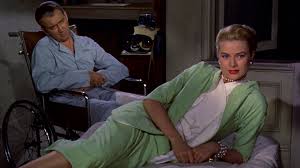
Just take the set. An entire New York backyard built inside a studio where you can watch the going-on’s in all the opposing apartment. It is a voyeurs dream and try as we might it is difficult not to be a little fascinated with the lives through the windows of all these people. In fact you never really notice that this is a studio setting, it feels very real. As in so many other of Hitchcocks films the story never leaved this backyard and so we are as stuck here as L.B. Jefferies (James Stewart).

He is a professional photographer with a leg in cast and therefore stuck to a wheelchair in his apartment. From here his only entertainment is to look out his window and into the apartments of everybody else in the opposing building. This interest out of boredom soon become voyeur obsession of a decidedly unhealthy nature. He watches Miss “Torso”, a skimpily clad dancer, feels with Miss “Lonelyhearts”, a woman so lonely she pretends to have dates, listen to the music of the composer neighbor and so on. 

Then one day the salesman right across from him, who always fights with his wife, starts acting weird. The wife is gone, he leaves and returns several times in the night with a suitcase and he is doing something with knifes, saw and ropes. Jefferies is convinced that the man, Lars Thorwald (Raymond Burr), has murdered his wife.

There are two women in Jefferies life. Stella (Thelma Ritter) is the nurse attending his leg and general needs and Lisa (Grace Kelly) is his girlfriend. Both are upset with Jefferies voyeurism, but once he fields his murder suspicion they are converted immediately and a just as much obsessing as he his. Stella has a penchant for the macabre and Lisa I suspect do it because it is a way into the heart and life of the man she love. He is reluctant about marrying her, but as soon as she enters the adventure his look on her changes for the better so it works.

Jefferies calls his police detective friend Doyle (Wendell Corey) repeatedly, but every time Doyle refuse the allegations. There are always perfectly good explanations to what Thorwald is doing.
Here we are at the heart of the story. Jefferies, Lisa and Stella are clearly on an unhealthy voyeur trip. They are the kind of busy-bodies who are drawing conclusions about other people based on vague hints and fantasy. Exactly the kind of garbage you read in gossip magazines. Doyle is the voice of reason and common sense, but they are so entrenched in their murder story that they are hardly listening. Then when they start sending Thorwald notes, dig up his garden and break into his apartment they are clearly crossing the line of acceptable behavior. It is very suspenseful and even more so because I know it is wrong what they are doing.

So, is Thorwald a murderer or is he an innocent victim of serious harassment and slander? This was the part I did not remember and if you do not know it either, please, read no further.

We see something early on that Jefferies is missing because he is asleep. At a time where Thorwald is supposed to have killed his wife he is leaving his apartment together with a woman that looks like his wife. This ties in very well with the information Doyle, the police detective, provides and I felt quite convinced that the man was innocent. Therefore when Jefferies, Stella and Lisa are caught red handed, Lisa quite literally, I am sure there is hell to pay and frankly they deserve it. Yet when Thorwarld enters Jefferies apartment, presumably to knock some sense into him, he is revealed as an actual murder, that they were right all along. I really had not seen that one coming and actually at first I felt deceived, but now thinking about it I realize how clever Hitchcock is. Just as Jefferies is deceived by what he sees when he watches Thorwald so are we deceived. Just because we see more than Jefferies does it does not mean that we see and know everything. We are still only watching through the rear window and are making the wrong conclusions. 

I still do not know who Thorwald left with that morning and I still do not know how that ties in with the murder, but the point is that it does not have to. We simply do not know everything that is going on.

It is a genius plot and an excellent story, but it is the execution that really bears the Hitchcock mark. The suspense is almost unbearable and the voyeur fascination is communicated so well that we balance between fascination and disgust. But we also have a brilliant dynamics between James Stewart and Grace Kelly. Yes, of course he is too old for her, but I only think that the first five minutes then I forget all about that. Kelly has one of the most angelic introductions in movie history. When she enters and bend down to kiss him I cannot help thinking he is the luckiest man in the universe. Yet when the male/female conflict rears its head I can also understand why he balks away. She is a strong woman and she intends to domesticate him as a trained dog and of course he is rebelling against that. It feels like an irrelevant sub story at first, but it leads up to the bonding that happens when she joins the voyeur obsession. So clever.

This is one of the truly great Hitchcock film and one that is as good today as in 54. I love it. My wife loves it and I am sure you love it as well. Unless of course you do not like being fooled by a clever director.
  

Saturday, 4 July 2015

Les Diaboliques (1954)


Rædslernes Hus


A French horror movie from 1954. That sounds like enough of an oddity to make it interesting and I bet that is a very small sub-genre of film. Add to that that this particular film, “Les Diaboliques”, allegedly challenged Hitchcock into making “Psyco” and I am starting to become really interested. Oh, and the director created the sublime suspense of driving explosives across a dangerous mountain in “Wages of Fear”. Now I almost cannot wait. This just have to be good.

Mostly my anticipation was rewarded but only mostly. Some things worked less than great and I think that a comparison to Hitchcock is a bit of a stretch. That is mainly because some elements do not hold up as well today as they did in 54 whereas Hitchcock’s best movies has not aged a day.

Yet, what Clouzot, the aforementioned director (and producer and writer), does well he does really well and that is the suspense of looming disaster. If you have a hard time getting through the initial part, just hang on. The last 15 minutes are sublime. 

The setup is actually interesting all on its own. Christina and Michel Delassalle own and manage a boarding school somewhere in France. Christina (Vera Clouzot) is originally from South America where she may have been a nun and the funds to start the school came from her. Michel (Paul Meurisse) brought her back to France and is acting as headmaster of the school. Michel is a sadistic tyrant and Christina is suffering from some heart disease that makes her weak and she has apparently been just about to die for a few years.

The third person is Michel’s mistress, Nicole Horner (Simone Signoret) who is a teacher at the school. Nicole and Christina are friends and united in their hatred for their sadistic and brutal master. We learn that a revolt has been stewing for some time and now the two women are ready to take action. They execute an elaborate plan where they lure Michel out of town to a place owned by Nicole where they sedate Michel, drown him and take him back to the school in a whicker basket. There they dump him in the overgrown pool. A few days later however the pool is emptied and the body is gone. Then the two women are getting hints that Michel or his ghost is still around. The children see him, he is staring out of a window when a group photo is taken and he sends dry cleaning back to the school. WTF! This, together with a growing sense of guilt, especially in the religious Christina, is driving the two women crazy and they start arguing to the extent that Christina kicks Nicole out if the school. Christina herself is growing more and more frantic and paranoid and the last 20 minutes of the movie is pure torture for her.

I like this idea of the wife and mistress ganging up on the evil husband and lover. I sort of understand Christina’s motive, living under the thumb of this bastard and unable to get a divorce because he has to consent besides the religious constraint on her. She has to strike back somehow. Nicole’s motive is more obscure. Michel is treating her just as bad as his wife, but since they are not married she could just walk away. We have to believe that she simply wants to get back on her tormentor and that only works half way for me. 

The scenery is great, absolutely fantastic actually. The school look horrible, the kind of place you would hate to send your children and as a site for something evil and mysterious it is just perfect. I also love all those shots of townscapes and the small Citroën van. There is something very French about it. Charming and menacing at the same time.

The other excellent element I have to mention (again) is the suspense near the end and that is largely due to Vera Clouzot. Throughout the buildup phase she is balancing on a knife’s edge of a believable portray of a desperate woman haunted by doubt and overdoing it and losing that believability. Her state of mind is so frail that she is just about the worst conspirator to a murder, yet in that scene in the apartment with Michel tyrannizing her we see her make up her mind and that explains a lot. It is in the conclusion however that she really pulls through. Her nervousness gets perfectly translated to us that we also wonder what is haunting this school and her night walk through the corridors is just nerve wracking. First class suspense and it is her as much as direction and scenography.

On the negative side the buildup is just a trifle too slow for a modern viewer. This is a horror movie and the horror only really starts with half an hour to go and only in the last 15 minutes we are really getting our money’s worth. But then again, in 54 that would probably have worked fine. Hitchcock did many movies with very long buildups. The chock effects may also seem a bit lame for a modern viewer, we are just too jaded for this sort of thing. I liked the movie better when we did not know what was going on, before the big reveal.

The biggest problem however, and the reason I do not scream masterpiece here, is the detective Alfred Fichet (Charles Vanel). He is sort of imposing himself on Christina as some sort of 1954 Colombo and has the uncanny ability to show up bizarrely at the most inopportune moments. What are the odds he would be there in the end? Why on Earth is he sitting in Christina’s bedroom starring at her? I think I can say without spoiling too much that there is no Mr. Delassalle ghost on the school, but Alfred Fichet is a little too good at being at the right place at the right time.

There are two explanations here. One is that he is necessary for the resolution of the story and his actions are therefore forced. If this is the case it detracts from the movie in my book. I just do not buy it.

The second explanation is that there is something supernatural about him. That he is a product of Christina’s doubts and religious beliefs and that he is there to defend and vindicate her. The more I think about it the better it sounds, but it could also just be me wanting to find excuses to in something that looks like a clumsy script.

I doubt a modern viewer will go sleepless over this movie, in fact parts of it may help you getting some sleep, but there is no denying that when it is good, it is really good. A bit like with “Wages of Fear” really.