Saturday, 26 March 2022

The Outlaw Josey Wales (1976)


Øje for øje

It is hard to think of a movie more quintessentially Clint Eastwood than “The Outlaw Josey Wales”. It is as if he condensed his most iconic roles to this date, from his days with Sergio Leone and as Dirty Harry, into a single character. Mannerism, attitude, politics, you name it. Josey Wales is, or would appear to be, the sum of Eastwood.

Josey Wales was a farmer in Missouri, when early in the civil war his homestead is raided and wife and son murdered by a plundering gang of unionist, known as Redlegs. As a result, Wales joins a band of Confederates chasing the Redlegs. When the war ends Wales has become a lean, mean, fighting machine and he refuses to yield. Good for him because the amnesty extended to Confederates was a scam and almost all of his band got massacred, adding more villainy to those Redlegs. Soon Wales is chased across the country and ever so often has to stop to take care of some bounty hunters.

Along the way, Wales pick up a motley band, including an old Native (Chief Dan George, a woman kept as a slave at a trading post (Geraldine Keams) and the leftover of a raided pioneer train (Paula Trueman and Sondra Locke). Not out of design, Wales is a loner, but he has not the heart to turn them away.

Finally, after making peace with the local Comanche tribe, Wales seems to be able to catch a break and be allowed to settle down, but, alas, fate is catching up with him…

Clint Eastwood is the quiet man, efficient, economic and extremely capable. Skills that come in very handy considering the large number of bounty hunters, soldiers and scum who are out to get him. This constant cat and mouse game results in an awful lot of dead cats and make up the majority of the movie. The rest is also classic Eastwood, human integrity among those considered least worthy. The old Indian who sold his soul, the fallen woman and the self-righteous pilgrims who learn who the good guys are. When Wales makes peace with the Comanche it is in opposition to the Indians as the murderous barbarians stereotype and show them as having more moral integrity than the representatives of the government, exemplified by the Redlegs.

This is all very Dirty Harry, very Eastwood and it is kind of fun and gratifying, until you, or at least I did, start to get an unpleasant feeling that this is Eastwood presenting himself as a saint. This was very much his movie, he directed and partly funded the movie and it functions very much as a vehicle for him. Josey Wales is just a tad too sharp with the guns, a little too good to those in need and a little too self-sacrificing. When we get to the final show-down things start to fly off the rails when Wales’ band take down a small army with Josey Wales himself lying on the ground shooting left and right, hitting someone with every shot. Yeah…

If I close my eyes to that stuff, this is really an entertaining movie and as I generally like Clint Eastwood’s movies, I enjoyed watching it. It is mostly afterwards, when I start thinking about it that it starts to taste foul and even then, I cannot rule it out. Who does not like a Robin Hood story?

Personally, I thought Clint was cooler in Sergio Leone’s rendition.


Sunday, 20 March 2022

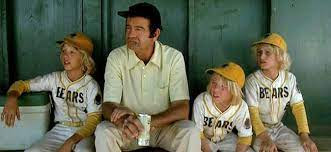
The Bad News Bears (1976)


Off-List: The Bad News Bears

The first off-List movie of 1976 comes highly recommended. “The Bad News Bears” is indeed the kind of movie that can make you forget for a moment the crappy things going on in the world.

Morris Buttermaker (Walter Matthau), a bum and former baseball almost-star, is hired to coach a team of 11-12 year old children. These are children nobody else wanted on their teams, outcasts for various reasons. Buttemaker is a drunk cynic as only Matthau could do it, he likes the money but makes no real effort. In their first game they are wiped out.

Buttermaker, who is coming to like the children, wakes up and starts making an effort, getting two talented children to play for his team, former girlfriend’s daughter Amanda (Tatum O’Neal) and bad boy Kelly (Jackie Earle Haley), and actually teach the children some baseball. Suddenly they start winning games.

The crisis of the movie happens when Buttermaker and his rival Roy Turner (Vic Morrow), coach of the rival Yankees team, get to think that winning is more important than the children. It has to almost fall apart before he realizes their intrinsic value as children rather than as ball players.

How can I not like a movie with Walter Matthau? I love everything he did, and his sheer presence is enough to lift otherwise mediocre films. This is also the case here and this is not a mediocre film to begin with, if for no other reason than there are a lot of children here acting, mostly like children would, unfiltered and un-idealized. Also, I will always love a story of misfits lifting themselves out of misery. Always have. Nobody is useless and winning is in itself pointless.

There are many such stories around and where this one is distinctly different is that <SPOILER!!!> they do not win the big trophy in the end. What matters is what they won as children. Confidence and a sense of belonging. For a child that is immensely more valuable than a silly trophy <END SPOILER>.

My main problem with the movie is that this sport itself is a complete mystery for me. I do not know the rules for baseball, never played it, never watched a game. In Denmark it is non-existent. I had no idea what the children were doing on the field, if it was good or bad, what was at stake or any of the tactical dispositions. I could only read from the expressions of players and coach if something was good or bad and was otherwise nonplussed by the whole thing. It gave me a feeling that the movie was speaking past me, expecting me to know a lot of things, which it therefore took for granted. Well, I suppose it is my own fault, but it does explain why I have generally avoided sports movies about sports I do not understand.

The second problem, which actually turned out to be the entire point of the movie, was that I was getting increasingly upset and frustrated with the attitudes of the adults and indeed the format of this tournament. It was all about winning. Weaker players had to be sidelined, success was “bought” by getting external star players and the teams are run as a professional entity with no room for the second best. In my own childhood I was crap at sports, but I did play along and being part of a team, win or lose, is fun, but it is not fun being humiliated. Leave that to the adults.

So much more gratifying was it when I realized that this was, at least mostly, the agenda of the movie. It was the adults, the winning-is-everything and kick-the-weak-when-they-are-lying-down attitude that was exposed as ridiculous. Seeing Lupus and Rudi being valued and included was extremely heartwarming.

Happy to say that you can watch “The Bad News Bears” despite knowing nothing of baseball. It says a lot about what matters to children and that is the important part. And that it features Walter Matthau.

Recommended.


Tuesday, 15 March 2022

Carrie (1976)


Carrie

This weekend my wife joined me to watch “Carrie”. This was only the second time she watched a List movie with me, but she is a lot more into horror movies than me and likes the remake. Neither of us had ever seen the 76 version by Brian De Palma and we were curious to see how that was holding up against the later version.

“Carrie” is one of the famous horror stories and one of the earliest from Stephen King. It is about a high school girl, Carrie White (Sissy Spacek), who is an outcast at school. Her life and sanity has been pretty much ruined by her zealously religious mother (Piper Laurie) and in school she is the shy weirdo everybody picks on. This we see a good example of right in the opening where Carrie is getting her first (but late) period in the gym shower. She panics as nothing had prepared her for this and is in return mocked and ridiculed by her peers. Only her gym teacher can see this is wrong and stands up for her.

It is prom time and one of the girls, Sue (Amy Irving), wants to make amends and asks her boyfriend Tommy (William Katt) to ask Carrie to the prom. Reluctantly she goes. Chris (Nancy Allen) is an entitled bimbo who did not take well to the penalty for harassing Carrie. Her vengeance includes arranging Carrie to be crowned Prom Queen and then get doused in pig’s blood. To this end she enrolls her boyfriend Billy (John Travolta). Unfortunately for everybody Carrie has mysterious superpowers and faced with ultimate humiliation she rains vengeance on everybody.

The core of the story of course is a victim pushed too far. I am thinking that 20-30 years later this could well have been a school shooting rather than witchcraft. In that case very few would have sympathized with the mass murder and destruction, but the interesting thing with “Carrie” is that we do, or at least I do, sympathized with her and cheer her on in her rampage. She becomes a monster but a righteous monster.

There is the religious motif, which ruins her, but also prepares the ground for her. It makes her see the world in that strange light of intense religious indoctrination. This is then closely linked to the sex and blood theme, the unclean woman with her period and the special powers ancient beliefs gave menstruating women. Sex, blood, religion and school harassment. Somewhere in that mix it is not difficult to understand why Carrie blows a fuse.

No doubt this is a great horror movie, but if I should dare to criticize it, then I do not really see the need for her magic powers. They seem unnecessary for the story, and it would not have been that difficult to have found a mundane way to wreak havoc on her tormenters. I do not think it would have been less juicy, but I guess there needed to be a link between sex, blood and witchcraft.

My wife’s verdict was that the remake is better. It is certainly clearer in its message. Only the bad guys die there, whereas the original Carrie makes no distinction. Everybody goes down with her, friend and foe. I am not certain which version I prefer. Sissy Spacek was pretty awesome in her bloody dress and with bulging eyes.

A solid recommendation from me.


Saturday, 12 March 2022

The Killing of a Chinese Bookie (1976)


Mordet på en kinesisk bookmaker

I have to admit that if feels odd to write reviews of forty+ year old movies at a time when it seems like the world has gone crazy, sort of like fiddling while Rome is burning, but I guess there is something comforting about dreaming yourself away to a simpler time. Or was it, really?

My first 76 movie is “The Killing of a Chinese Bookie”, a John Cassavetes movie. There are two things you know when you are going to watch a Cassavetes movie: It is going to feel like you have been invited inside somebody’s real life and two, that whatever is the theme the take on it will be different from what you are used to. That sounds great, really, but in the case of “The Killing of a Chinese Bookie” this is a sad and depressive life in a dismal world.

Cosmo Vittelli (Ben Gazzara) is a nightclub owner. Not one of those glitzy places, but the seediest kind imaginable. I cannot say I have much experience with nightclubs, but “Crazy Horse West” is the epitome of poor taste and low appeal. It may have aspirations at art, but what it produces is pathetic and boils down to tits. It is one of those places that make you feel dirty and immensely sad. Yet Cosmo is proud of his place, and he genuinely likes his girls. It makes him feel like a hotshot and in his head, it is a lot more than what we see.

Unfortunately, Cosmo has a bad gambling habit and when he loses 23.000$ to a bunch of gangsters he is forced to take the shitty deal to kill a competing Chinese gangster to get out of his debt. Against all odds Cosmo pulls it off and survives which was not according to plan, so now the gangsters are after him.

The slice of life style is so typical of Cassavetes and in this case it gives us a lot of insight into the life of Cosmo Vittelli and his world. It is gritty, people are not that smart, conversation is often dumb and people think they are a lot cooler than they actually are. As if they kid themselves by pretending to have a better life than they really have. This depression overlays everything like a duvet, making their only chance at staying sane and afloat to believe in the lies they tell themselves. Which is essentially Cosmo’s speech at the end of the movie.

Yeah, I know, this is supposed to be a crime story about an assassination and a bunch of gangsters, but if found the plot quite irrelevant. This is not really about murders and violence, but about a life where you have to take shitty deals. You are an imperfect being and that is the kind of balls life throws at you. This is all about Cosmo and his desperate struggle to stay afloat and pretend all is great.

A lot has been made out of this really being about Cassavetes himself and his film crew trying stay afloat, making the actors a parallel to Cosmo’s strippers, exposing themselves for peanuts and getting disrespected for it. Maybe that is so, I do not know. I understand the story well enough without that level of narcissism.

“The Killing of a Chinese Bookie” is not a bad film, but it is a film where not much happens and what happens is rather unimportant and it therefore feels empty to watch. When it ends, it feels abrupt, in the middle of the story, but that is because the real story of Cosmo has gone on for long enough. Those who watch it as a crime story are going to get disappointed and those who do not, will just get super depressed. And those watch it for the tits will just end up feeling dirty.

I know I should appreciate the movie, but it just made me more depressed than I already am.


Saturday, 5 March 2022

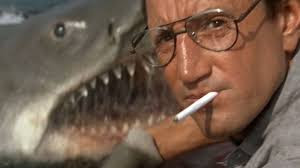
Jaws (1975)


Dødens gab

This is my last movie of 1975 and with “Jaws”, the year ends on a high.

Shockingly, I never watched this movie before and yes, I may be the last person on the planet to see it. In my youth the reputation of “Jaws” was so that I thought this was way too scary for me to watch and for the past decade I knew it would be coming up, so I wanted to save it for now, to fully enjoy it as a first viewing. Whether that makes sense or not, I do not know, but I did feel the full impact on this viewing, so the wait has been worth something.

I totally loved “Jaws”. I have heard it said that it is dated and that the shark looks fake and all, but that was not my impression. I sensed the terror of that shark, I did urge those children to get out of the water and I did jump in my seat when the shark suddenly appears behind Roy Scheider on the boat. In short, it worked. The “du-dum du-dum du-dum” that heralds the shark is legendary stuff, every child, including my son, knows what that means and hearing it makes me move to the edge of my seat, looking all over for the shark.  Sure, jumps scares is a staple by now and there are bigger and bad’er monsters around whether they are called Godzilla or Putin, but this is the original.

For the very few un-initiated, this story takes place on an east coast island, Amity Island, modelled on something like Martha’s Vineyard, where the summer holiday season is about to begin. We see a young woman taking a night swim when something unseen is taking her, dragging her around and finally pulling her under. Scary stuff. When she is found in pieces, Chief Brody is alarmed by what appears to be a shark attack, but the mayor and the business owners are strongly opposed to closing the beaches. More people will have to die before personal financial interests yield to common sense. Some things never change.

Eventually big game hunter Quint (Robert Shaw) is tasked with hunting down the shark, and he ventures out with shark expert Hooper (Richard Dreyfuss) and Chief Brody. They are in for some interesting fishing.

What happens out there is a magnificent chase, but who is chasing who? Quint is modelled on Captain Ahab of Moby Dick and the shark is his great white whale. It is personal with him, and it almost feels as if it is personal to the shark as well. The shark is his personal menace as it is a symbol natures revenge on humanity in general. Brody and Hooper are just as much fighting the shark as fighting their own demons.

Yet, forget about themes and analyses, this is primal hunting and primal fears, and it is expertly orchestrated.

It is easy to forget that Steven Spielberg was young once and had to start somewhere. This was only his fourth directional effort, the previous three being mainly small productions, but the direction in Jaws is that of a pro (with my feeble insight) and as good as anything he did since.

Also great to see Richard Dreyfuss again. His is one of my top tier actors, though mostly as a comedian. Roy Scheider has one of the best lines in movie history (“We are going to need a bigger boat”), but to my mind Robert Shaw is totally stealing this picture. His mad captain Ahab persona is the most interesting character by far and he does it absolutely perfectly.

Swimming in the ocean was never the same after this movie.

Du-dum du-dum du-dum DU-DUM DU-DUM...


Wednesday, 23 February 2022

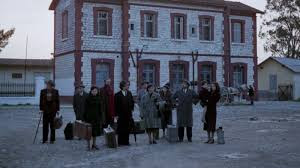
Travelling Players (O Thiassos) (1975)


Skuespillernes rejse

Recently there has been quite a lot of movies that have been… different. Sometimes in a good way and sometimes in a less good way. “The Travelling Players” (“O Thiasos”) is definitely different and I am leaning towards it being that in a less good way.

“The Travelling Players” may have a plot, but I was not able to discern it. Being rather confused, I checked the Wikipedia page and there I found a plot summery that I did not recognize at all. What I saw was a story that was jumping forward and backward in time, sometimes mid-scene and usually without explaning that we were now in a different time. The earliest scenes seem to be 1939 and the latest scenes 1952. They are all in Greece and they all feature a group of travelling actors. To me, it looked as if the troupe is fairly consistent throughout, which is a little bit odd since members of the troupe are frequently shot to death and I should suppose the children would grow up over the span of 13 years. I never got much of a relation to any of the characters and I knew as little about each of them by the end as in the beginning. What they are basically doing are moving around, trying to set up the same show and usually getting interrupted (violently).

There is a part of me believing that the reason I cannot discern a plot is because I am lacking an understanding of the background for what I see. There is clearly a lot of references to Greek history in those years and while I do recognize German or British soldiers, everything else is just a blur of names and various people fighting.

Another part of me hopes that I am not supposed to recognize a plot (and therefore not entirely imbecile), that this is not a progressive story but a series of tableaux of a rape on repeat. The raped victim is the Greek population represented by the players. They cannot settle, they cannot get on with what they are doing (setting up a show) and they are subjected to violence, degradation and internal strife as everybody and their mother is fighting over them. According to this interpretation we see an endless fighting with external and internal enemies. Nobody is right, nobody is wrong, but everybody terrorize the civil population in the process and the result is a broken populace in poverty and misery.

I have no idea if this interpretation is correct, but that it should be a depressive one is a given, considering the hopelessly gray and winterly cinematography. This is very far from the sun-soaked Greek vacation image I have of Greece from my visits there. Not even Athens in the wake of the debt-crisis looks this sad.

“The Travelling Players” is also an example of what happens when the director is allowed all the running time he wants and therefore skip the trimming part of the editing. Angelopoulos takes all the time in the world to tell this story (three hours and forty minutes). A story, which is essentially a scene on repeat. In this sense it reminded me a lot about “Jeanne Dielman”, with the difference that I was a lot less confused there. Maybe the extensive running time is an image on how long the people had to suffer?

Confusion is indeed the prevalent feeling throughout, together with depression. Mostly I would be watching, hoping for something to anchor my understanding until that point where I gave up hoping and just resigned to accept that is about the Greeks getting raped again and again by everybody including themselves.

If this sounds like something for you, go crazy. The movie is available in full length on YouTube. The poster for the movie on Wikipedia is not in doubt. It sports the headline: “One of the Best Films in the History of World Cinema”. No less. Edited down to half the size it might have half a chance at that. As it is I cannot honestly wish this movie on anybody.


Wednesday, 16 February 2022

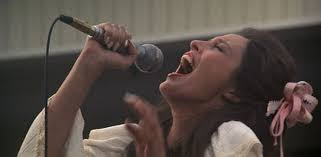
Nashville (1975)


Nashville

I do not like country music. Like in, I really do not like country music. That is a pretty important detail when you watch a 2½-hour long movie about Nashville, Tennessee, of which at least an hour consists of country music performances. It is bound to color my view on the movie.

This is a rambling movie with an enormous cast and uncounted storylines that may or may not interact. I have not recognized an over-all plot and that somehow does not feel important. In this sense it reminds me of Robert Altman’s earlier movie, “MASH”, where the buzz of the place is the objective rather than a traditional story arc.

Everything centers on the place, Nashville, and the music. In Nashville, that means country music. All the characters have an angle on the music. They are performers, wannabe performers, fans, promoters, exploiters, groupies or just hanging around because this is the place to be. You get a very clear feeling that in this place, everything revolves around the music industry and that all these people interact in strange connection with the sole purpose of promoting themselves to get a slice of the cake. Whether it is Opal (Geraldine Chaplin) pretending to be  from the BBC to get close to the action, Winifred (Barbara Harris) who has run away from her husband to pursue a career as a singer and tries to squeeze herself in where she can or Haven (Henry Gibson) who is working hard to maintain his star status to gain influence, and on and on. There is a singularly personal, if not selfish, angle to all the characters as if only they really matter.

I cannot tell if this is a celebration of Nashville or a ridicule of same. There is an element of satire, even mockery at times, of these people, but everybody acts in earnest and are dead serious about all this. This is what makes it funny, but also uncomfortable as when people do not understand why we are laughing at them. I also get this feeling that where I see a satirical exposé, others will see a love letter to everything that is great about this place.

My lack of understanding may stem from the fact that I am very much an outsider. As a foreigner, both to the country and the culture, and to the music, I am not qualified to judge this movie. I can enjoy it as a crazy spectacle and I can cringe over the music, but that can only be my personal view. I have a feeling Robert Altman was torn between love and disgust making this movie and that does make it oddly schizophrenic.

I am quite convinced fans of the music hail this movie as a masterpiece for getting into the soul of it and just as convinced that opponents to the culture that digs country music hail this as a masterpiece for exposing the hypocrisy, egoism and idiocy of it. Either way, everybody is happy.

This may also be the first movie on the List with the great Jeff Goldblum in an, albeit small, role. Those goggles are absolutely awesome and so is his bike.

I still dislike country music with a vengeance and while it did make it hard to get through the movie at times, there is no denying that on the whole I enjoyed the movie quite a bit.