Sunday, 7 April 2024

The North (El Norte) (1982)


El Norte

If you thought Illegal immigration is a new thing, then you are mistaken. “El Norte” tells us this issue was pretty much the same 41 years ago as it is today. Only the magnitude can be discussed.

Rosa (Zaide Silvia Gutiérrez) and Enrique (David Villalpando) are siblings in Guatemala. Because their father is trying to set up some sort of protest against abuse from, presumably, the landowners, he is shot and their mother is taken away, presumably killed. The siblings only survive by hiding. Seeing they cannot stay they decide to go to “El Norte”, to the promised land in the North where everybody have flush toilets and a car.

They manage to get through Mexico easily enough, but in Tijuana on the US border they run into trouble. The first agent they find to help them across the border tries to mug them and then they are picked up by immigration and sent back. The second attempt fares better but costs them their only valuables and involves a long crawl through a rat infested sewer. Something that eventually proves fatal.

In the US things are not as great as they could have hoped. There are people who are willing to hire illegal migrants, but the pay is very low and the risks are high. There is the constant threat from the “Migra” (Migration authorities) and without papers there is no health or any other official protection. All of which are issues Rosa and Enrique run into and which lead to a downbeat conclusion.

The striking thing about this movie is, as mentioned above, how timeless this story is. Change the cars and haircuts and this movie could have been made today. In this movie the migrants are fleeing Guatemala, but it could be from anywhere in the Global South. There is a strong motivator to move in the physical prosecution Rosa and Enrique are subjected to, but there is also an obvious economic lure, which plays a large part in the movie. The US is the place these people dream of whenever things are hard. This story could also just as well have played out in Europe. Then the crawl through the sewer would have been replaced by a dinghy across the Mediterranean.

The political point the movie is trying to make is to see illegal migration from the point of the migrant and present the risks, indignities and desperate hopes of these. What of course is not covered here is the other side of the coin, why this kind of immigration is illegal. I think there are some pretty good arguments why governments want to control immigration, but from the point of view of the migrant, all those points are completely irrelevant. The consequence is that they end up in a lawless limbo.

From a production value point of view, I had some misgivings going in as this promised to be a second-rate production, but that is not the case at all. Production value is pretty high and the acting, especially from Gutierrez and Villalpando, is convincing. They strike the right level of naive determination, and we instantly sympathize with them. Both went on to have long careers in movies and TV.

There is a level of melodrama here, it cannot be otherwise or there would be nothing to drive the movie forward, but what stroke me most watching it, was the looming threat of disaster just over the horizon. Every step of the way, from Guatemala and to the end in Los Angeles I get the sense that Rosa and Enrique are walking on a precipice and often they are not even aware of the danger they are facing, blinded as they are of their hopes and needs. It actually made it difficult for me to watch as I constantly counted all the may ways this could end badly and, in a sense, I was not disappointed.

I am not certain I would want to watch “El Norte” again, this is not a feel-good movie, but I guess it classifies as an important movie that tells a story people need to hear.


Monday, 1 April 2024

Trading Places (1983)


Off-List: Trading Places

The first Off-List movie of 1983 is “Trading Places”, a big childhood favourite of mine. I cannot tell how many times I have watched this over the years and while it may not hold up as well today as it did back then, it never fails to amuse me. This time I watched it with my wife and son and based on his reaction to it, this was his first viewing, it still works.

Randolph (Ralph Bellamy) and Mortimer (Don Ameche) Duke are wealthy commodity brokers (Duke & Duke). Stingy, prejudiced and arrogant, they have the kind of money where it does not matter what people think of them. In between their never ceasing pursuit of making money, they have an ongoing discussion on heritage vs. environment. Eventually they decide to conduct an experiment: They will send their star executive into the gutter, while picking a desperate type from the gutter and make him their executive. The value of the bet: 1$.

The star executive is Louis Winthorpe III (Dan Aykroyd), as arrogant and prejudiced as the Dukes and of “good breeding”. The gutter type is Billy Ray Valentine (Eddie Murphy), presently employed begging money pretending to be a crippled Vietnam veteran.

Louis takes really badly to having everything taken away from him. Without his status and his money, he is nothing and only with the help of the hooker Ophelia (Jamie Lee Curtis) does he stay afloat, sort of. Billy on the other hand eases into the role of commodity broker very easily. With the help of the butler, Coleman (Denholm Elliott), he is soon unrecognizable from the street thug he used to be. This lasts until he learns the truth about the bet (and that there is no-way the Dukes will have a black man leading their business). Now Billy, Louis, Ophelia and Coleman are on the warpath to take down the Dukes.

A modern take on The Prince and the Pauper tale, this is not a novel story, but in my poor opinion the best rendering of it ever done. It plays as a comedy, but except for some scenes on a train, it stays well inside the probable and makes us invested in the story. We are amazed with Billy, and although it is difficult not to feel a bit schadenfreude with Louis, we do feel with him as well. He is just so utterly helpless. Maybe Billy is a little too good a commodity broker for somebody picked up from the street, but explanation would be that street smarts is transferable into the commodity market.

The comedy is mostly slightly underplayed, with hints and asides and of course Murphy doing some of his idiosyncratic shenanigans. By today’s standard the comedy is way-underplayed, but my claim is that this is exactly why it works. The afore mentioned train sequence is the exception. Here we venture deep into silly comedy and according to the extra material the studio wanted to ditch this part. Thankfully, they did not. Silly as it is, it is also hilariously funny and comes at exactly the right point of the movie. Amazingly, after this intermezzo, the movie is able to jump straight back into probable land to provide us with a very satisfying and believable finale. That it is not free fantasy is reflected by the fact that today there is a law against insider trading known as “The Eddie Murphy rule”, based on “Trading Places”.

John Landis had a good streak at the time and “Trading Places” is definitely Landis classic. It is a good example of his type of movies. For Aykroyd, Murphy and Curtis, “Trading Places” was a huge boost to their careers, it is likely they would not have gone where they did without this movie and at least for me, this is the movie I associate all three of them with. I also love how the movie showcases Elliot, whom I mostly know from the Indiana Jone franchise, Ameche and Bellamy. All three belong to the old guard and they bring a lot to the movie. Don Ameche had not acted in a feature for a decade, but went on a roll after this one. I loved his role in Cocoon.

Yet, for all this, the greatest impact of “Trading Places” is the personal one it had for me. I loved it throughout the eighties and nineties, and it was one I always could take out if I wanted a good time and it still is.

Seriously, why was this movie not included on the List?


Wednesday, 27 March 2024

Videodrome (1982)


Videodrome

David Cronenberg is (in)famous for his disturbing movies and “Videodrome”, his entry onto the Lis, gives us a lot of classic Cronenberg to, well, enjoy.

Max Renn (James Woods) is heading a small television station that specializes in seedy stuff nobody else cares to air. This particularly includes porn and violence and when lab technician Harlan (Peter Dvorsky) picks up a grainy signal from Malaysia depicting very real looking sadomasochistic scenes, Max is sold. He gets Harlan to tape as much as possible and learns it is not from Malaysia at all but from Pittsburgh and is called Videodrome. It is also essentially snuff porn as nobody leaves alive.

Max meets Nicki Brand (Debbie Harry, yes, the one from “Blondie”) and the video presence of a professor called O’Blivion on a  talk show and quickly hooks with her. Turns out she is really into this Videodrome stuff, so she leaves Max to audition for the show.

At this point I was convinced this was a decent into violent pornography, the stuff that makes you want to take a shower after even hearing about it, and Max mission to save Nicki from the clutches of a sinister, underground cabal. In the process, of course, Max will learn the error of his ways.

I was wrong.

The movie takes a strong left turn as Max discovers that the Videodrome signal is used for mind control and the function of the actual pictures is to draw the attention of the viewer. All the sex thing is just a red herring. The mind control makes the viewer hallucinate and often drive the victim crazy. Max is targeted for this mind control and while his world is turned seriously weird (a hole is opening in his stomach, things are coming out of the television etc.), he is turned into a killing machine, to kill the enemies of his controllers. Sort of “The Manchurian Candidate” on acid.

By the time the movie ends, I, the audience, cannot tell what is real and what is hallucinations as it all blends together. This is also the impression I am sitting back with. Accepting the premises of the movie, when I try to follow the narrative, at some point I get lost. Is it dreaming, hallucination, reality or insanity? This confusion keeps the viewer off balance, which is good for suspense, but also threatens to send the viewer into resignation as the narrative cease to make sense. It is a tricky balancing act, and I am not entirely certain Cronenberg manage to keep that balance.

There are smart moves though. The first 15 minutes focus on violent pornography emulates the way Max is drawn into the Videodrome world. Videodrome is not about pornography and neither is the movie, but for both it is the hook.It is supposed to fascinate the dirty mind to want to watch more and thus be subjected to what comes after, the real agenda. It also taps into the idea of mass media as an agent for mind control. This is not new at all, and Hollywood is far from done with that idea, but doing it through the tv screen, targeting particular viewer segments through the choice of the carrier signal is, I think, novel. In 83, home video and easy access to seedy stuff was clearly taking off big time and this strange new world was ready for exploration.

Unfortunately, as for most movies exploring technological novelties, it also makes the movie feel dated. The wonders and magic of the tv signal and video cassettes all look antique by now.

What does not look outdated, though, are all the body horror special effects. Hallucinations or real, the scope and execution of all this weirdness is nothing short of amazing. In an age before CGI, getting these things to look real was really hard and I found them convincing. Others may disagree.

I am not certain where I land with this movie. I understand and appreciate the cleverness of “Videodrome”, but I am not certain I follow it all the way to its conclusion. Rather, I feel I dropped off the wagon somewhere around two-thirds in. In all likelihood, there are a lot of fans out there, but I am not entirely convinced.


Friday, 22 March 2024

The Draughtsman's Contract (1982)


The Draughtsman's Contract

A good movie is a movie that stays on your mind for a long time, but is it also good if it stays there because you are desperately trying to work out what it was all about?

We are in England in the late seventeenth century where the artist Mr. Neville (Anthony Higgins) gets a contract to make a series of drawings of the Herbert country house. The drawings are supposed to be a gift from Mrs. Herbert (Janet Suzman) to her husband. Mr. Neville are reluctant to accept the job but when the contract come to include access to Mrs. Herbert’s body, he accepts.

At the Herbert mansion, Mr. Neville commandeers everybody around for the purpose of the drawings and particularly Mrs. Herbert’s son in law, Mr. Talmann (Hugh Fraser), is ruffled by Mr. Neville’s presence. For a long while, the movie is about Mr. Neville drawing, using Mrs. Herbert and arguing with especially Mr. Talmann. That is, until Mr Herbert is found dead in the moat. Mr. Neville is convinced he will be accused of the murder, if for no other reason than everybody disliking him.

Some time later he returns, has sex again with Mrs. Herbert and is murdered by Mr. Talmann.

Okay, clearly there is a lot more going on, but then I will be starting to guess and be on pretty thin ice.

There is an exaggeration in the movie that pervades everything. The dialogue is fast, refined and elaborate and, yes, quite difficult to follow. The outfits, especially the wigs, are even by seventeenth century standards big and over the top and worn everywhere. The foppishness is rivalling Versailles and while it makes the movie interesting to look at, it is difficult not to see all this as a point. Mr. Neville is the exposer of the hypocrisy and idiocy of the idle rich and seems to enjoy that he can commandeer everybody around, mock them and literally screw them over. That makes the movie an exposé of the foibles of the privileged class, something they rarely like.

When I try to get a step deeper, I run into a wall of confusion, primarily from the dialogue. Maybe my English is simply not good enough, but often I would sit back and realize I had no idea what was going on. Again, this may be intended, a lot in this movie appear to be there to confuse us, such as the strange, unexplained living statue, but then again, it could just be my inadequacy.

As a murder mystery, it leaves us mystified. We never learn who killed the man. Instead, we get a lot of accusations thrown around. Everybody seems to have had a motive, yet only one is suitable to take the blame. Again, that may be the purpose.

The more I think about “The Draughtsman’s Contract”, the more I realize there must be a lot more hidden here, that the story is deeper than the foppish circus we are served. That is frustrating, but also interesting, and probably a good reason to watch it again.

Another good reason is the fantastic score by Micael Nyman. At first it sounds like authentic period music, but there is an underlying exaggeration and even a beat that reveals it as a modern score pretending to be of the seventeenth century. It is quite clever and pure bliss to listen to.

Peter Greenaway’s movie has the air of a mockumentary, a distortion of reality to prove a point, which is more or less the kind of movies he made before this one and although it is not playing for laughs, there is a wry humour here that makes me accept my complete confusion.


Saturday, 9 March 2024

A Christmas Story (1982)


A Christmas Story

Christmas movies are a category on their own. During the holidays, they are everywhere, but outside that narrow period from late November until New Year, they entirely disappear. A few of them do work outside the season (“Die Hard”, “It’s a Wonderful Life”), but most feel... flat... when Christmas is far away. Maybe this is why the List features very few Christmas movies and that most of those belong to that first category. I believe “A Christmas Story” is the first thoroughbred Christmas movie I have encountered on the List, and, yes, it does feel sort of weird to watch it in March.

But let us pretend this is December, it is dark outside, and the coffee table is stuffed with Christmas cookies. Now we can consider “A Christmas Story” in the right frame of mind.

Ralphie (Peter Billingsley) is a 9-year-old boy living with his younger brother, Randy (Ian Petrella), his mother, Mrs. Parker (Melinda Dillon) and his father, the “Old Man”, Mr. Parker (Darren McGavin) sometime in the forties. Christmas time is coming up and all Ralphie wishes for Christmas is the Red Ryder BB gun. This is not a popular choice and everybody, his mother, teacher, even the department store Santa tells him he “will shoot his eyes out”. Ralphie then cooks up a million schemes to get the toy for Christmas, some of those are quite inventive.

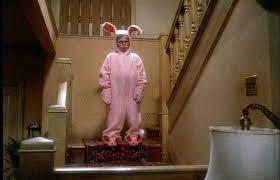
While this is the main story, “A Christmas Story” is a meandering tale with tons of small subplots fleshing out the life of Ralphie and his family. We see a boy in his class getting his tongue stuck on the flagpole. Ralphie tries to bribe his teacher. The Old Man wins a hideous lamp shaped like a woman’s leg, setting off “the battle of the lamp” with his wife. Ralphie gets the hate-gift of any nine-year old boys when he gets a pink bunny suit from Aunt Clara and is forced to wear it (the best laugh of the movie). In fact, it is not wrong to say that all these small vignettes are the movie.

Ralphie is a truly annoying little boy, but I suppose that is also the point. As it is told in retrospect, we remember all these great or exciting things form our childhood, but objectively, they were perhaps not that fantastic and we were hardly the angels we think we were. Presenting Ralphie as obnoxious is such a point and works great for comedy, though less good for the ears.

Child-Ralphie’s point of view is of course a child’s point of view and at that age there is a lot of magic, wonder, strangeness and mystery to life. Small problems are big problems and big problems just pass over the head. Life in the Parker home is full of small adventures, disappointments and injustices. What matters from a child’s perspective is just different from that of an adult.

Christmas is of course the central event here and what can be bigger for a nine-year old boy? Reality is... eh, a bit more messed up and that mess is really fun to watch.

Curiously, “A Christmas Story” is not a staple Christmas movie in Denmark. I do not remember ever having watched it before and I wonder why this is. It is a Christmas movie far above the average junk we are fed with during the holidays and I could easily believe this would be a classic elsewhere. Whether it will become a Christmas classic in our home I am not so certain. Both wife and son found the voice of young Ralphie truly annoying.


Tuesday, 5 March 2024

A Question of Silence (Stilte Rond Christine M.) (1982)


De stilte rond Chistiane M.

“A Question of Silence” (De stilte rond Christine M.) was a difficult movie to find, but I am happy I did. Rare movies are often rare for a reason, and I do suppose “A Question of Silence” is something of a fringe movie, but at least it is an interesting one of the sort.

Janine van den Bos (Cox Habbema) is a psychiatrist called in to assess the sanity of three women who have committed a gruesome murder. The three women have admitted to the murder, feel no regrets and are complete strangers to each other. Why would they do such a thing if not insane?

As Janine spends time with them in prison, she slowly realizes that this is not just a murder, but something bigger.

Christiane (Edda Barends) is a housewife with three children, who has no other content in her life than taking care of the children and wait on the husband who clearly sees her as no more than that. Christiane has turned catatonic.

Andrea (Henriette Tol) is a secretary to an executive of a large company. She is clearly very smart and highly skilled, but management cannot see beyond her being a secretary, although she has potential for so much more.

Annie (Nelly Frijda) runs a diner where she must suck up to scummy men who think they have a right to abuse women.

On the day of the murder, all three women are in the same clothes shop when the (male) clerk catches Chritine stealing. As a response they kill him viciously.

What Janine finds out is that the clerk is unimportant, it is what he represents, the oppressive males, that matters. The act of murder is a rebellion against the patriarchy and something which the women see as a win, not a crime. The court, dominated by men, fail to see that point.

So, the big question is, did fighting the patriarchy justify the murder, or was this a bestial murder on an innocent man doing his job? This, I suppose is what viewers and critics has been discussing ever since and the reason this is considered a great feminist movie.

There is no doubt that the three women believe that their misery is due to men and there is also no doubt that the men immediately around them are selfish pricks who feel superior to the women. This includes Janine, whose husband is a conceited ass. The premise of the movie is that this is a systemic fault and men must as a consequence be fought, simply because they are men. If you are a militant feminist, you may agree with that.

Personally, I find the idea interesting, but ultimately wrong and misplaced. Or maybe I am just too male. There is a (sadly fundamental) human trait that inclines us to blame an outside agent for the misery in our lives rather than taking a hard look at ourselves. Once this agent is identified, we fix it by fighting and killing it. Then we are absolved from blame and get an outlet for our frustration. Ruthless politicians have used that trick for centuries and it is found right down to the school playground. To me, the cases of the three women are no different. There are a hell of a lot more rational ways to deal with their problems than to commit murder, but it is so nice and easy to have so simple and cathartic solution at hand. Just ask Hamas. Or the Nazis.  

I am not dismissing the frustration and predicament of the women and I do not blame them for thinking men are imbecile pricks, but I dare say that many of the systemic problems for women has improved over the years through means that did not involve killing anybody but by women taking action to improve both their own and other women’s conditions. As any woman would tell me, we are not there yet, but going back to the women of the movie, I am quite certain that today, a smart girl like Annie could get a glorious career in another company with a less narrow board, it would be acceptable for Christiane to ditch her worthless husband and, well, Andrea would need those bums as customers, but at least today I doubt she would need to take such shit from them.

I am glad conditions and opportunities are better for women today than they were forty years ago and I am proud of the girls who fought for it. Luckily very few men have had to die in the process, but I guess it takes movies like this one to get there.

“A Question of Silence” is more interesting and thought provoking than I expected and while I cannot follow it all the way, I was happy to have watched it.


Wednesday, 28 February 2024

Fanny and Alexander (Fanny och Alexander) (1982)


Fanny og Alexander

It has been about a month since my last post and, yes, I did spend a week on a winter escape, but mostly the wait is due to the length and pace of this, the next movie on the List. “Fanny och Alexander” comes in a cinematic version of 188 minutes, but of course I happened to buy the miniseries version clocking in at a whooping 312 minutes. It was a tough one to get through and it did not help that work has been very busy. Anyway, finally done.

It is Christmas time 1907 in the home of the Ekdahls in Uppsala, Sweden. The Ekdahls are wealthy, so the party takes place in their palatial home stuffed with domestics and expensive furniture. We get the entire Christmas party in close to real-time, I do believe it is longer than the wedding in “Deerhunter”, and the amount of detail is incredible. I noticed that they have the almond present and the dance through the halls to the song “Nu er det jul igen!”, both Danish traditions, though I would not be surprised if they actually originate from this movie. Danish television has had a long tradition of airing “Fanny och Alexander” during Christmas and this Christmas scene is the only thing I remember having watched before. In any case, the Christmas party serves to introduce us to the numerous members of the Ekdahl family and show us how happy they are.

Fanny (Pernilla Allwin) and Alexander (Bertil Guve) are the grandchildren of family matron Helena Ekdahl (Gunn Wålgren) and children of theater director Oscar Ekdahl (Allan Edwall) and actress Emilie Ekdahl (Ewa Fröling). In this environment Alexander’s imagination is sincerely encouraged. Then, shortly after Christmas, Oscar suffers a stroke and dies. Emilie tries to carry on running the theater, but eventually she abandons it and marry the town bishop, Edvard Vergerus (Jan Malmsjö). The bishop is a hard and religious man who believes in austerity and discipline, a combination that goes down very poorly with the children. His regime of punishment and degradation makes Emilie regret, but there is no way the bishop will let go of her and the children.

“Fanny och Alexander”, I understand, is supposed to be, to some extent, autobiographical, which actually makes a lot of sense when you watch it. I can see Bergman as Alexander being born into a creative theater world and I can see how an encounter with the bishop would mark you for life. In fact, if half of this is autobiographical, this movie would offer a Freudian explanation for most of his movies.

It would also explain some of the more illogical elements of the movie, first and foremost why Emilie would want to marry Edvard. It does not take more than a glimpse of the man to see this is a bad match and any lingering doubt evaporates when he opens his mouth. Her explanation makes very little sense unless she is a complete idiot and incredibly selfish. The only explanation that works is… that it actually happened, which I am inclined to think.

Alexander experiences a number of magical or spiritual moments, such as seeing ghosts or his encounters at the home of Isak Jacobi (Erland Josephson). It is easy to see a lot into this magic, but I prefer the simpler explanation of Bergman’s representation of creative imagination, the vent of his inspiration, At eleven years of age anything can become magic.

While the Ekdahls are clearly the good people (and privileged), the Vergerus are the bad guys. You need go no further than the interior décor, clothing and lighting to be convinced of that. There are no grey zones here. Christian ascetism as the source of problems is a recuring Bergman theme. The Jewish Jacobi household has a curios role here. As friends of the Ekdahls, they are clear members of the good side, but as a free agent, they can operate in spaces the Ekdahls cannot, both practically and spiritually.

In summary, “Fanny and Alexander” is not a bad movie, but it suffers from wanting to tell too much. The long version I watched is easily two hours too long. Isolated, the many details may be interesting, but they also serve to distract for the core of the story. As narratives, the many detours are simply not interesting enough and I get impatient and distracted. The Ekdahl brothers Gustav Adolf (Jarl Kulle) and Carl (Börje Ahlstedt) are the comic relief as the movie’s Thomson twins, but sadly not funny enough for that (a classic Swedish problem).

For me, personally, suffering children are deeply problematic to watch and here their suffering is drawn out for hours. In the end we see much less than we sense, but it was still hard for me to endure.

“Fanny och Alexander” won four Academy Awards, but not for editing. That one was a big fail. Cut out about three hours and we are down to something that would work. The miniseries version I simply cannot recommend.